

We come into the world with a brilliantly complex mixture of plans and instructions, written through our biology. This colorful playbook includes the hue and shade of our skin. The color of our eyes. Whether our ear lobes are attached to the side of our heads or if they’ll flap freely in the wind.
These instructions contour our face to hint the reflections our families see in the mirror. This topography suggests a familiarity that is easily accepted by those who have been waiting to catch their first glimpse of who we are and who we might be.
These instructions determine if our strength and creativity will be in our right hand or left. It instructs the vast network of neural connections that determine how that will play out as we reach out to touch the world.
The playbook includes the strength and sound of our voice, the colors and patterns of our hair, our propensity to fall victim to certain ailments and diseases, and how we will define what means “self.” All written in the most basic – and yet beautifully complex – script that has defined life from the beginning.
One set of instructions determines if we’re born with testes or ovaries, a penis or a vagina. Because calling out “it’s a penis!” “it’s a vulva!” might seem a tad cringey, we resort to the first of our many check-box assignments and rely on “it’s a boy!” or “it’s a girl!” to announce which blanket to pick: Pink or blue.
After our chromosomes have done their work – our biology if you may – we set out to apply the window dressing of what those chromosomes are going to mean for the newly-born. That adornment comes from our culture, our religion, and increasingly, our politics.
In the US, the very idea of “this is a boy” versus “this is a girl” is a societal (and religious) construct. How that child will be dressed, who they play with, if their hair will be long or short, what their roles are going to be in the family and in the community, etc., are all based in our religions and our culture. This is where we take to nurturing nature into what we feel it should look like, act, identify as, and be.
It is easy to settle into this culturally-defined, binary categorization. It feels safe. It is encouraged and rewarded at almost every turn. When the playbook that put us together is turned over to our culture to raise, checkboxes allow us to immediately know what rules to apply. The proclamation of length, weight, and count of fingers and toes accompanied by the obligatory boy/girl pronouncement provides the content for the way we are introduced to our family, our community, and ultimately, the world.
However, since the beginning of time, our self-identity has been far more complex than our outward appearance. Who we feel safe with, who we are attracted to, how we’re comfortable presenting ourselves to the world, and how we want the world to interact with us. All buried deep within the biological playbook that instructed our development from conception.
Our sexuality is how we see and identify ourselves. Sometimes it is a source of comfort, an outer wrapper that matches societal expectations. For some, when it conflicts with the societal norms we’re brought up with, it can be deeply confusing and uncomfortable. Not necessarily because of personal discomfort but rather, because what feels familiar, what feels right, conflicts with what others are telling us.
Mechanically, it can be viewed as simple. Tab A fits into Slot B and if the moons align, propagation can occur, intentional or not. The species continues and lo and behold, our very existence is reduced to reproduction. But is this what really defines us as who we are and what we can be? Or are we more beautifully complex?
Does an artist’s work fade if they did not have a child that carried their genes? Do the words of an acclaimed author disappear without genetic representation in the next generation? Does the love of two people mean nothing if their matching Slot Bs didn’t create a child but instead, raised a family? A family of artists? Or scientists? Or humanitarians? Or good humans?
How our playbook rolls out
Babies are not born with an innate sense of gender. It is something they are taught. In general, our kiddos play with the toys they are given, interact with the playmates in a sphere created by their environment, and are exposed, pretty much daily, to information that tells them what is considered “girl behavior” and “boy behavior.” Some children act more gregariously and rough-and-tumble, regardless of their gender. Adults around them label the behavior as acting “like a boy.” Some are more reserved, perhaps gentler, and prefer to “play house with dolls.” Their actions are labeled more feminine.
There is, of course, nothing wrong with observing behaviors in terms of traditional gender roles. That is, unless a child is ridiculed and repeatedly corrected for a behavior that is an authentic representation of who they know themselves to be. Small seeds of doubt and discipline for acting “incorrectly” based on the gender assigned to them at birth can grow into trees of insecurity and dysphoria that can have long-term, detrimental impacts.
A young girl who plays with trucks and prefers jeans to dresses certainly does not mean that they’re transgender or non-binary. Boys who prefer to wear dresses or play with dolls are also not necessarily transgender. Nor is there anything wrong with those behaviors or actions. They are expressing their sense of self, what makes them happy, and what feels right.
Consistent, insistent, and persistent expression of a different gender than what was defined at birth is broader than just observed behaviors and clothing choices. It’s often the child who continually tells a trusted adult that they are a different gender than what they were initially defined to be. They struggle against the gender-oriented expectations placed on them and with social interactions that are gender-defined. As body changes accelerate and the window of societally accepted ambiguity narrows, they find themselves strangled by a future that slowly sucks the light from their life.
What is gender affirming care? A great question and one that seems to be missing in the race to slam the door shut on access. What it’s not is probably just as important as what it entails. It is not just medication. It is not just surgery. It is not a quick solution based on whim. And it certainly is not brainwashing or child abuse.
If anything, it is the opposite. It’s an environment of open-mindedness where caregivers act on a primal need to support and protect their children. Where medical professionals work from decades of empirical data to determine effective and safe therapeutics that return dependable and consistent clinical results. And where a questioning young adult can be heard.
Gender-affirming care, as defined by the World Health Organization “encompasses a range of social, psychological, behavioral, and medical interventions designed to support and affirm an individual’s gender identity when it conflicts with the gender they were assigned at birth.”
According to Jason Rafferty, MD, MPH, a pediatrician and child psychiatrist who provides gender affirming care at the Hasbro Children’s Hospital in Rhode Island, “the goal is not treatment, but to listen to the child and build understanding – to create an environment of safety in which emotions, questions, and concerns can be explored.
What if the child changes their mind?! This seems to be a common backdrop for the idea that innate sexuality is a choice as opposed to an identity buried deep within a child’s biology and chromosomes. It can certainly stem from a personal perspective where, as an adult, you cannot imagine a scenario different than your own. Your own experience with who you are and your gender seems so deeply understood that you can’t fathom someone else who has a different experience than your own.
And yet, everyone’s experience with identity is different. We are beautifully and complexly created with the ability to develop our own sense of self and perspective. Appreciating – and accepting – those differences doesn’t detract from who we are but rather, celebrates how majestically different we can be.
Gender affirming care listens to those differences and helps the individual explore what that means. The outcome is self-directed, not manipulated, and the benefits of feeling heard are immense. For children, this can mean simply that: Talk and support. Support that often can even save a life.
When that child starts to go through puberty and the physical aspects of those changes are deeply confusing and psychologically painful, puberty blockers that have been used for decades are available to help slow the physical progression while a youth is figuring things out.
These are medications that have also been successfully and widely used for some time, when the onset of puberty happens too young. Known as precocious puberty and marked by breast development before the age of eight or testes growth before the age of nine, this is treated with hormonal suppressants. This treatment is fully reversible, safe, and effectively delays a child’s development until they are ready.
Ready. Ready to fully understand their body. Ready to process the changes that puberty brings. And in a space where those around them are developing in a similar way.
For a child who has expressed a different gender identity than what their physical attributes demonstrates consistently, insistently and persistently, this pause button is a chance to fully understand who they are and how they will interact with the world around them.
Any parent who has found a sympathetic ear and medical care to help with a child who is struggling with a medically manageable challenge, knows the relief of finding that solution. It’s not desperation, it’s determination that drives those parents forward, knowing that their child finally has the option of moving forward in a world that has, to that point, confounded them. This is amplified when their child has spent years of struggling in a world where the only solution their child has found was leaving it.
Legislation to stop this age-appropriate, medically necessary care for transgender, non-binary, and gender-expansive youth across the country has taken off like wildfire, leaving parents, youth, and medical professionals scrambling and at a loss for how to proceed.
Politicians are once again, stepping into the exam room with the intent to disrupt or destroy conversations and decisions that should be between a medical professional, caregivers, and the youth caught in the cross-hairs of this fight.
Who do we fall in love with?
Similar political battles are being fought over not only who a person is but also, who they can love. Sexuality and gender identity are how we see and identify ourselves, not who we have sex with (to put it bluntly). Sexual orientation is how we navigate that sense of self in the world of others.
Broadly stated, if, and when we fall in love with someone, it’s because they fulfill some part of us that is missing. Or some part that is enhanced by the presence of someone else. We seek companionship. We seek a feeling of acceptance. We seek someone who we can’t imagine our lives without. A best friend. A soulmate.
We tend to seek other members of our species to build and share our life story. There is a pool, millions strong, to choose from. People from across the globe or people we have known since childhood. Although this may be difficult to process and understand, our gender really has little to do with who we seek and find love with unless the only reason for companionship is reduced to biological procreation.
We are more beautifully complex than that and minimizing our existence only to who we can Tab A and Slot B, create a baby with, takes that inherent complexity and waters it down to pure biological survival of the species. What a waste to think that way when there are so many amazing things that can come from connecting with a very special person, enjoying their company, depending on them when we are down and rejoicing with them during life’s highs. Those are the life stories that create art, that create inspiration, that create stability and home.
There is nothing biologically wrong with a societally defined female finding that companionship with another female. Or a societally defined male finding love with another male. Or a transgender man to finding that love and companionship with a biological female or male.
Gender identity has nothing to do with sexual orientation. Who we are attracted to, who we feel safe with, and who we love is biologically directed. For that person to be a specific gender based on the checkbox assigned to us at birth, is culturally, religiously, and/or politically defined.
At the end of the day, those pairings think about the same mundane things that most couples contemplate. What’s for dinner? Did someone pick up the mail? Who is helping the kid who hates math finish their homework? These relationships do not denote a biological deviance, they simply throw a monkey wrench in the societal, religious, and political ideas about what a couple or a family should look like and how that connection produces children, inherits wealth, pays taxes, and exists in a societally constructed, binary world.
With so much talk of “government overreach” and the right to live life without governmental intervention, the hypocrisy of then limiting those freedoms to only those who fit a heteronormative, biblically-based paradigm is breathtaking.
We are a country that was specifically founded to be free of religious tethers.
Any religion.
Using 2000-year old texts and tenets of one specific religion to advance and support political agendas and legislation that strips youth and families of their right to proven, safe, and effective medical treatment is egregious and devastating to the families involved.
Have we been here before?
The Institute for Sexual Research in Berlin worked hard to understand and provide a safe space for those struggling with their gender and sexuality. The Institute provided a sounding board, counseling, and psychological and medical treatment. They worked through sexuality fluidity, recognized the boundless beauty of those who didn’t pull an easy answer to the blue or pink – the Tab A and Slot B – questions. They very much understood that sexuality is how you see and identify yourself, not who you have sex with. And that stigma and legal and social punishment shouldn’t be attached to attraction. And they strove to build understanding and acceptance throughout German society.
This was not in the 2020’s but rather, the 1920’s.
On May 6th, 1933, the Deutsche Studentenschaft marched, accompanied by a brass band, to the doors of the Institute, broke into the building, destroyed tens of thousands of publications and academic works relating to the study of sexuality, murdered Dora “Dörchen” Richter (the first known person to undergo complete male-to-female sex reassignment surgery), and launched a persecution of LGTBQ+ that culminated in the first target for genocide with the Nazi march towards Christian Nationalism.
Despite generations of reality in Germany where being gay, lesbian, or trans was widely tolerated and accepted, Hitler’s rise to power on January 30, 1933 was marked by his first target – his first group to vilify in a campaign of cleansing – the German queer community was front and center to suffer. And suffer they did.
As referenced by Thom Hartmann, “German states put into law bans on gender-affirming care, drag shows, and any sort of “public displays of deviance,” enforcing a long-moribund German Law, Paragraph 175, first put into the nation’s penal code in 1871, that outlawed homosexuality. Books and magazines telling stories of gay men and lesbians were removed from schools and libraries.
Thus, a mere five months after Hitler came to power, on May 6, 1933, Nazis who showed up at the Institute, hauled over 20,000 books and manuscripts about gender and sexuality out in the street to burn, creating a massive bonfire. It was the first major Nazi book-burning and was celebrated with newsreels played in theaters across the nation. It wouldn’t be the last: soon it spread to libraries and public high schools.”
In 1929, the process towards complete decriminalization of homosexual acts had been initiated within the German legislature, codifying accepted practice within the German community of acceptance. In 1933, the rise of the Nazis fanned the flames lit through book burnings and ultimately an estimated 50,000 gay men were imprisoned for their sexuality. 10,000 to 15,000 were deported to concentration camps. Most died in those camps for the simple crime of being born with the non-conforming expression of who they were and who they loved.
Four years from a society that was moving to accept their LGBTQ+ members to a brutal cleansing based in the idea that homosexual relationships did not produce the future children who would “make Germany great again.” Beautiful, creative, expressive lives demonized and then pushed to extermination under the heading of “rooting out the vermin who were destroying the country from within.”
The echoes of Hitler’s hatred are being breathed back into today’s world through the sparks that ignited flames of the past. An all-out assault has been waged against our fellow LGBTQ+ citizens. One could argue that this war has its basis in “othering.” Singling out and focusing on a vulnerable, often misunderstood group, with manufactured fear-mongering to destabilize a citizenry. “This particular group is to be feared and is causing harm” followed by the hollow promise that once that group is removed by the actions of certain leadership, peace will return.
In Germany, the list of those who fell victim to this practice of “othering” by the Nazi regime started small and grew to include gay men, Jews, Poles, Black people in Germany, Jehovah’s Witnesses, people with disabilities, and many others who were exterminated in the campaign to purge society of those who weren’t white, Christian nationalists.
In the United States today, we are seeing similar campaigns through legislation, campaign call-outs, and explicitly defined words in the Project 2025 document created by the Heritage Foundation as a roadmap for the first 100 days of the next Republican presidency. This document pulls no punches when it comes to outright and extreme attacks on the LGBTQ+ community. It states:
“The next conservative President must make the institutions of American civil society hard targets… This starts with deleting the terms (“DEI”), gender, gender equality, gender equity, gender awareness, gender-sensitive, abortion, reproductive health, reproductive rights… out of every federal rule, agency regulation, contract, grant, regulation, and piece of legislation that exists.” (p. 4-5 Mandate for Leadership: The Conservative Promise)
The “mandate” goes on to characterize any legislation, organization, or outlet that discusses “transgender ideology” as proponents of the “sexualization of children.” Those who support civil right protections for the LGBTQ+ community are labeled as “child predators and misogynistic exploiters of women.”
“Their product is as addictive as any illicit drug and as psychologically destructive as any crime. Pornography [as defined as anything that discusses the LGBTQ+ experience] should be outlawed. The people who produce and distribute it should be imprisoned. Educators and public librarians who purvey it should be classed as registered sex offenders. And telecommunications and technology firms that facilitate its spread should be shuttered.”
These words are warmed up versions of the Nazi’s 1930’s agenda that led to the extermination of anyone who didn’t fit the heteronormative, Christian nationalistic trope of the time.
For those who have pondered how so many millions were murdered during the Holocaust while the world looked on and did nothing, the open publication of the Project 2025 manifesto provides a good look at how that happened.
In conclusion.
Since somewhere between five and seven million years ago, our biological playbook has ridden firm while societal norms, religious expression, politics, and a myriad of other forces swirl about, providing the rules du jour that push and pull our experience with our identity and how we manifest within our reality. Biologically, that playbook is brilliantly expressive and diverse in how we define and view ourselves and how we exist with our fellow humankind.
Despite the societal, religious, and political pressures, we are compelled to create our own story. A story that includes what is me and what makes us. Us as families, companions, citizens, colleagues, partners, and friends. And a me that is one’s authentic self, written deeply in a script that supports the breathtaking beauty of who and what we can all become.
Historian and documentarian, Ken Burns, spoke recently about this during commencement exercises at Brandeis University.
“I have had the privilege for nearly half a century of making films about the US, but I have also made films about us. That is to say, the two-letter, lowercase, plural pronoun. All the intimacy of "us" and also "we" and "our" and all the majesty, complexity, contradiction, and even controversy of the US. And if I have learned anything over those years, it's that there's only us. There is no them. And whenever someone suggests to you, whomever it may be in your life that there's a them, run away. Othering is the simplistic binary way to make and identify enemies, but it is also the surest way to your own self imprisonment…”
That imprisonment, he says, quoting author James Baldwin, comes from within and is based in the blind belief in “this or that doctrine, this or that delusion of safety, this or that lie.” The heavy price we pay as a society for this behavior is paid by those groups of our fellow citizens who are simply acting on the playbook written into their DNA. That complex, breathtakingly beautiful script that doesn’t fit within the narrow, binary, checkbox-oriented definitions espoused by a Christian nationalistic rhetoric focused on limiting freedom and maintaining ultimate control.
Our country’s DNA includes the right of every citizen to enjoy life, liberty, and the pursuit of happiness. This is not conditional on the slim definitions of a religion – any religion. It is not limited to only those living in certain states. Or those who have the protections of wealth, or fair skin, or power.
We must move past the manufactured desire to create “others” who we can vilify to better position specific parties or policies. At the end of the day, we all strive to live out our own unique playbook and our lives, regardless of the checkboxes that the true others are using to quell the beauty that is our authentic me and us.
_________________
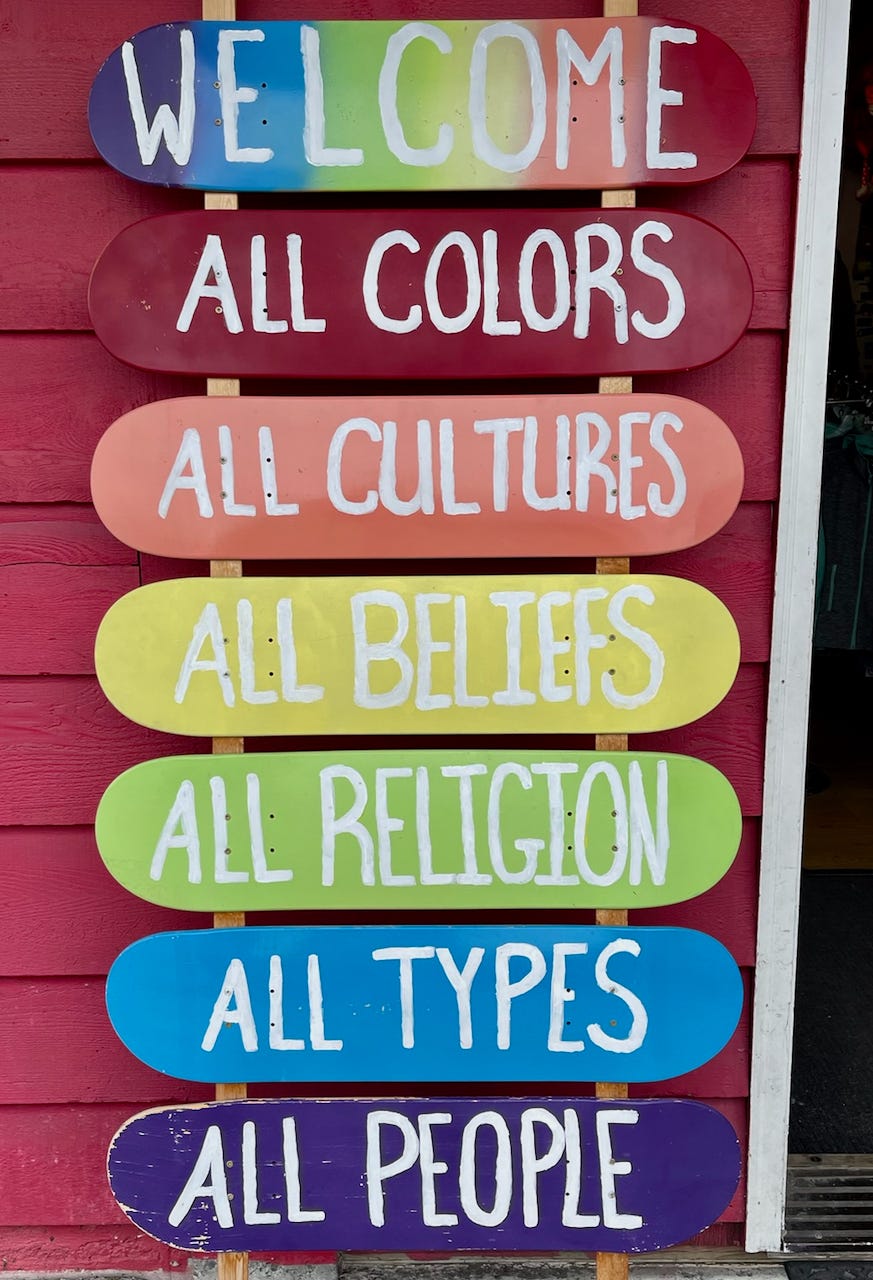
Of note and worth repeating.
Sexual orientation, gender identity, hair color, and flappy ear lobes – all written in that fabulous playbook we are born with – have no impact on one’s ability to do a job. Or serve one’s country. Or make dinner.
The names that we are given at birth serve the purposes of our parents. The names that we choose for ourselves later in life, express who we are. Be they nicknames, married names, or wholly different names that better describe who we grow to know in ourselves are our own prerogative. Resisting use of a name someone asks to be called is dismissive, rude, and completely self-centered.
Gender identity is broader than birth certificate checkboxes. No one chooses to be lesbian, gay, bisexual, transgender, queer, gender expansive, or questioning any more than one chooses to be straight and heterosexual. Those titles express who we are (our identity) and who we are attracted to and choose to be with (our sexual orientation). They make up the complex and beautiful interaction with have with ourselves and the world in which we live.
Pronouns are a creation of our language to express a societal and religious construct. Being offered what pronouns someone chooses to use to define themselves is a gift. It their way of saying “this is who I am” so that others do not have to guess. Treat this gift with the respect that is due to someone who is gently handing us a guide to who they are.
Learning a new name for someone you have known by another name can be difficult. It’s okay to make mistakes and to fumble as it is often with those moments where we can have the best conversations with those who are finally able to show us who they truly are. These are the times of vulnerability where our best intentions can build a bridge and trust.
Transgender folks do not “dress up” or “act” transgender to do anything other than exist in their own skin. Continually assigning some level of sexual deviance to everyday actions like using a public bathroom is saying more about the overly-sexualized ideation of the person complaining than the transgender individual going about their daily life.
Gender affirming care includes a whole suite of therapeutics that are based primarily on open, honest, and ongoing talk. Gender reassignment surgery is not performed on minors and is never done on a whim.
Drag shows are performance art. Pure and simple. They have no other intent than to entertain. Especially in these times, entertainment that can make us smile, laugh, and enjoy spending time together is a precious gift that we should all appreciate.
Literature and books from and about the LGBTQ+ experience are not pornography. They are mirrors and windows. Mirrors of who we are. Windows into the experience of others. Labeling these books as pornography is not about the words on pages but rather about instilling fundamental Christian nationalism, packaged in a glossy white box with a pink OR blue bow, and sold to Americans as “grassroots efforts to protect our children.” The movements hawking that box are proclaiming loudly that American will be safe when it is white, straight, wealthy, patriarchal, and bound by biblically self-justified moralistic rules, handpicked from a 2000-year old text. (See my June 2024 Substack post Book Bans are not about Books)
References:
Annie E. Casey Foundation, Defining LGBTQ Terms and Concepts, April 25, 2023. Link here.
Vanderburgh, R.. Appropriate therapeutic care for families with prepubescent transgender/gender-dissonant children. Child and Adolescent Social Work Journal.
Boyle, Patrick, What is gender-affirming care? Your questions answered. AAMC: Association of American Medical Colleges, 2022. Link here.
Responding to transgender victims of sexual assault. Office for Victims of Crime. Link here.
Steinmetz, Katy. Why LGBT advocates say bathroom ‘predators’ argument is a red herring. Time. Link here.
Gates, Gary J., Jody L. Herman, Transgender Military Service in the United States, Williams Institute, UCLA School of Law.
Acosta, Joie D., Matthew Chinman, Amy L. Shearer, Countering Sexual Assault and Sexual Harassment in the US Military. RAND Corporation, Link here.
Impact of Transgender Personnel on Readiness and Health Care Costs in the U.S. Military Likely to be Small, RAND Corporation, Link here.
Schaefer, Agnes G., Radha Iyengar Plumb, Srikanth Kadiyala, et al, Assessing the Implications of Allowing Transgender Personnel to Serve Openly, RAND Corporation.
Bradley, Michael, Michael Phelps, Katie Ledecky have unusual advantages as swimmers. We should ban them, right? June 23, 2022. Link here.
Coleman, Eli, Walter Bockting, Marsha Botzer, et al, Standards of Care for the Health of Transsexual, Transgender, and Gender Nonconforming People, World Professional Association for Transgender Health (WPATH)
Anti-Trans Bathroom Bills Have Nothing to Do With Privacy and Everything to do with Fear and Hatred. Link here.
What Percentage of Americans are LGBT? Link here.
An essay that just nails it! I used to teach the sociology of gender at a university from the same perspective as you express here, Dani -- and I will never forget the student who came to my office after that course one term and wept tears of joy. He told me that what I told the class during that term had made it possible for him to come out and be who he was.
Excellent essay. I have shared it with a private left group. Our local community is having their Pride celebration this weekend in a VERY red area. This would be such a great source of information for the detractors if only they would read it but you know SCIENCE!