
Is This Communism?
The same accusation, aimed at different Americans, at two different moments in time.

Here is a party platform. See if you recognize it.
It calls for expanding Social Security, broader unemployment insurance, better health care for all our people, and a higher minimum wage, crediting itself with raising wages for more than two million workers already. It backs unions and collective bargaining outright: “we are strongly behind the idea of unions.” It insists on equal pay for equal work regardless of sex, and on eliminating discrimination in employment because of race, creed, color, national origin, ancestry, or sex.
It calls for the federal government to fix regions stuck in persistent unemployment. And it created a new cabinet department, over objections that it was overreach, to house federal responsibility for health, education, and welfare.
It says labor built this country, not as a slogan but in these words: “the men and women who with their minds, their hearts and their hands create the wealth that is shared in this country. They are America.”
It says the Constitution guarantees “the blessings of liberty, due process and equal protection of the laws” to all people, and it calls citizenship, for anyone born or naturalized here, “an unqualified right, regardless of race, creed or color.”
It supports an immigration policy built on “equality of treatment” and “freedom from implications of discrimination between racial, nationality and religious groups,” and takes credit for a Refugee Relief Act that gave asylum to thousands fleeing Soviet-controlled Europe.
Say some version of this out loud at a dinner table today and you will hear the word. Socialism. Communism. Big government run amok. You may hear it from a neighbor over the fence, or a co-worker at the water cooler, or a fellow parishioner over the pew. You may hear it on cable news. You may, if you are being honest, have thought it yourself.
Is this communism?
It is the Republican Party platform of 1956. Written for Dwight Eisenhower’s re-election. Adopted by delegates who considered themselves the last line of defense against radicalism, having just watched their own party nearly destroy itself chasing communists under the bed for years.
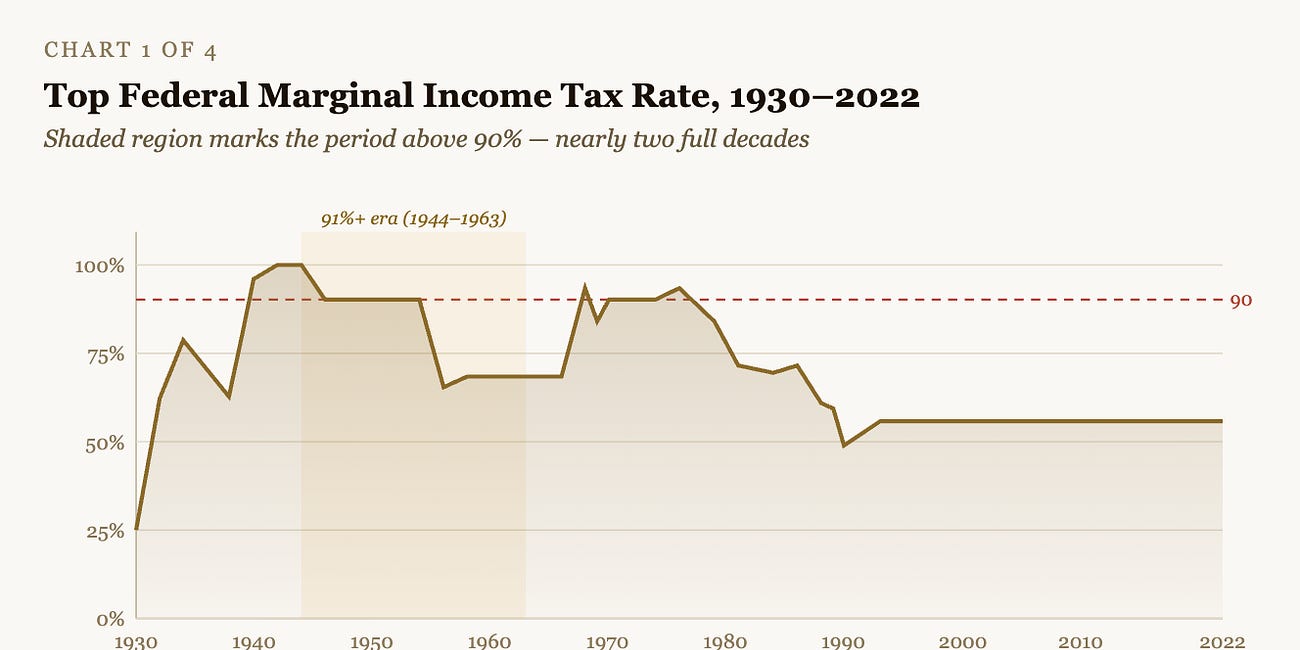
None of this was free. The top marginal tax rate on income above roughly $2 million in today's dollars sat at 91 percent throughout Eisenhower's presidency, not the 37 percent it is today. I've explained what a marginal rate actually means and done the fuller math elsewhere rather than repeat it here.
The platform did not emerge from nowhere. It emerged from a party that had just watched itself nearly come apart.
For four years, Senator Joseph McCarthy had turned the word “communist” into a weapon aimed at neighbors, accusing soldiers, diplomats, and professors of secretly serving Moscow on evidence that amounted to nothing. People lost their jobs. Some lost their careers for good. It took an Army lawyer named Joseph Welch, during the televised Army-McCarthy hearings, to ask the question the country needed to be asked: “Have you no sense of decency, sir?”
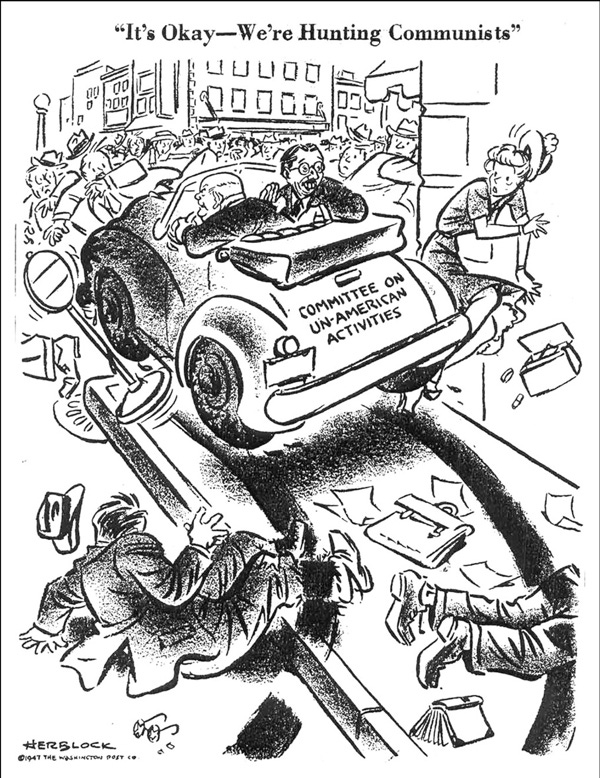
The Senate censured McCarthy that December. His crusade collapsed. He was dead within three years.
Eisenhower loathed McCarthy but avoided saying so publicly for years, unwilling, in his words, to “get down in the gutter with that guy.” Historians still debate whether that silence gave McCarthy more room to operate.
But when the 1956 platform was written, eighteen months after the censure, the party’s choice was unmistakable. It did not renew the domestic loyalty-test politics of the McCarthy years. It turned outward: containment abroad, an international development fund, support for the UN, and at home, an explicit widening of the circle.
A platform that had just watched its own party nearly consume itself hunting internal enemies chose instead to talk about who gets included.
Seventy years later, the language of internal enemies is back, delivered from a stage at Mount Rushmore. “You can be loyal to Karl Marx or you can be loyal to America,” President Trump told the crowd on July 3, 2026. “You can be a communist or you can be a patriot. You cannot be both.” He warned of “a resurgence of the communist menace in our land, including from newcomers to our country,” comparing its danger to World War I, World War II, Pearl Harbor, and 9/11. He did not name Zohran Mamdani. He did not have to.

The shape is the McCarthy shape: an undefined enemy category, a binary loyalty test, a claim that disagreement is really an existential threat. The same word, “communist,” is now doing almost exactly the opposite work that Modern Republicanism was built to move away from in 1956.
The same reversal runs through immigration. The 1956 platform sponsored a Refugee Relief Act specifically to give asylum to people fleeing communism, calling it a matter of “self-interest” and “responsibility for world leadership.” Its Cold War theory included welcoming the people communism had displaced. Trump’s speech runs the logic in reverse, framing some newcomers as communism’s delivery method rather than its victims. Same threat, same word, opposite conclusion about who it endangers.
It runs through citizenship too. The 1956 platform calls citizenship “an unqualified right, regardless of race, creed or color,” rooted in the Constitution, not in bloodline or how long your family has been here.
Trump roots belonging instead in an inherited “culture and character” that every American has a “core patriotic duty” to preserve unchanged. He does allow that “you do not have to be born here, but you do have to love what we have built,” which sounds inclusive until you notice what it actually demands: not equal legal standing, but demonstrated allegiance to a particular story.
Mamdani answers the same question from the opposite direction, standing beside newly naturalized citizens and calling the power to “determine what America means” something each of them now holds.
One of these three was a platform, argued over and ratified by a party. It located citizenship in the law. The other two were speeches, delivered from a podium on the same anniversary. They located citizenship in belief, and landed in opposite places.
The label, this time, arrived late.
By the time Trump stood at Mount Rushmore calling communism “a resurgence... in our land,” the tools of McCarthy-era enforcement had already been running for the better part of eighteen months, aimed not at a specific accusation of foreign contact, but at a broader category of dissent itself.
In February 2026, the Office of Personnel Management finalized a rule stripping job protections from an estimated 50,000 career federal employees, explicitly allowing removal for what the rule calls “deliberate obstruction of presidential policy.” The administration says this is not a loyalty test. The nonpartisan Partnership for Public Service called it a tool to “remove expert career federal employees who place the law and service to the public ahead of blind loyalty.”
Since June 2025, National Guard troops have been deployed to at least seven U.S. cities, nearly all of them run by the opposing party, at a cost approaching half a billion dollars in 2025 alone. Federal courts, including the Supreme Court on the Chicago deployment, have repeatedly found the administration lacked legal authority to do this. Crime data in several of the cities, Portland and Chicago among them, was already falling before the troops arrived.
Since May 2025, the Justice Department has sued more than thirty states for refusing to hand over complete, un-redacted voter registration files, including driver’s license and partial Social Security numbers, in what election law scholars call an unprecedented federal reach into state-run election administration.
And in Texas, in June 2026, eight people were sentenced to between 30 and 100 years in federal prison over a July 4, 2025 protest outside an ICE detention center, where one attendee shot and wounded a responding police officer. Only that one defendant was convicted of the shooting itself. Others received decades for standing nearby, for helping someone leave the scene, for moving a box of political pamphlets afterward. Federal prosecutors called it the first sentencing of an “Antifa” cell. Legal observers noted the sentences exceeded those given to participants in the January 6th Capitol attack.
None of that required the word “communist” to happen. And by the time the word showed up, at a podium, on the eve of an anniversary, it wasn’t aimed at a movement still waiting to prove itself.
Mamdani had been in office six months.
In that time his administration said it had closed a $12 billion budget deficit it inherited, largely through state aid, agency savings, and delayed pension payments, a characterization critics dispute as a bailout rather than a solution, but a result his supporters call proof the model works. He had also secured state funding to launch universal childcare and delivered New York’s first rent freeze covering both one- and two-year leases.
The rise of democratic socialist candidates in primaries around the country since January owes at least as much to that visible, contested, but real record as it does to any speech. The word did not arrive to head off a threat that hadn’t happened yet. It arrived after the thing it was warning against had already started producing results.
That sequence is worth thinking about. In 1956, the rhetoric of a specific, checkable threat came first, and the country built institutions, some of them deeply flawed, in response to it. In 2026, institutional action against a broad and largely undefined category of dissent came first. The rhetoric arrived afterward, reaching for a familiar old word to explain and justify what was already underway.
Here is another speech, given on the eve of the same anniversary.
It opens with the Lenape, who crossed New York’s waters in dugout canoes long before anyone called it New York, then moves through wave after wave of arrival: the enslaved brought in chains, the Irish fleeing a famine “manufactured by imperial cruelty,” Chinese sailors who settled what became Chinatown, Jewish families escaping pogroms, Puerto Ricans arriving after the Second World War.
It says the wealth of this country was built by “calloused, dirt-streaked hands,” and that too much of what they built has ended up “in the soft hands of a precious few.” It names a health insurance industry that “exploits the sick” and corporate landlords for whom “negligence is a business model.”
It insists immigrants did not arrive because the world sent its worst, that the old lie has been used against every group that ever crossed those waters, and that it was false every time.
It calls dissent itself patriotic: “Patriotism is every act of righteous dissent.” And it closes on this: the ideals of the founding “are strong enough to endure any authoritarian regime, but only if we reach for them.”
Is this communism?
It is Mayor Zohran Mamdani, addressing New York City on July 3, 2026, the day before America turned 250.

So what actually is communism, and what is socialism, since the word gets used as though everyone agrees what it means.
Communism calls for the abolition of private property in the means of production: not your house or car, but the factories, land, and capital that generate wealth. In practice, every government that has called itself communist has gone further, concentrating the economy, the press, and political power in a single party. That is a specific, extreme, historically documented thing. It is not a synonym for “government program I dislike.”
Socialism is broader and older, covering everything from full state ownership to the mixed economies of Scandinavia, where private property and private homeownership remain fully intact alongside heavy public investment.
Even universal healthcare, often the fastest word to trigger the socialism label, doesn’t require government ownership. Germany’s system, for instance, guarantees coverage for everyone through competing private insurers and privately run hospitals, a structure closer to tightly regulated capitalism than to Britain’s NHS, where the government actually owns the hospitals and employs the doctors.
Most American democratic socialists, including Mamdani, describe something much closer to the German or Scandinavian end of that spectrum: government doing more on behalf of people who work for a living, while leaving private ownership in place.
Take the rumor circulating about Mamdani’s own housing plan, Block by Block, that it is a step toward eliminating private property. Read the plan and you find the opposite emphasis.
It builds 200,000 new affordable homes and preserves 200,000 more. It doubles the city’s Open Door program to expand affordable homeownership, creates a new “Our Home” co-op program, and launches an Office of Deed Theft Prevention and a no-interest Mortgage Assistance Program to keep existing homeowners in their homes.
None of that eliminates private property. It makes homeownership reachable for people currently locked out of it.
Where the plan gets tougher is on corporate-owned rental housing, a large share of New York’s market: stronger code enforcement, tenant-scheduled inspections, “roof-to-cellar” inspection days for negligent landlords. That is not an attack on private property. It holds one specific category of large, often absentee owner accountable for basic habitability.
That combination, public investment paired with expanded private ownership, is not new. The 1956 platform claims credit for having “stimulated record home ownership” while also authorizing more low-rent public housing. Nobody in 1956 called that socialism. It was simply understood that a healthy housing market needed both tracks running at once.
So call this what it is, and call off the search for a scarier word.
Look again at what sits between the two moments in this piece. The 1956 platform was written by the same party that had just spent years hunting communists in its own government, and what it chose to build in the aftermath reads, today, like a checklist of what gets called democratic socialism now: expanded Social Security, broader unemployment insurance, a higher minimum wage, union power defended outright, health care and housing treated as government’s proper concern.
Nobody in 1956 called any of that communism. It was not treated as a radical departure. It was treated as the obvious way to bring a fractured party and a frightened country back together and make both of them stronger.
And it was proposed under a top tax rate on the ultra-wealthy more than double what it is today. The platform’s generosity toward ordinary people and its willingness to tax the very top were not two separate facts sitting next to each other. They were the same idea, paid for.
Neither the 1956 platform nor the democratic socialist movement of today is communism, or socialism in the sense the word has historically meant. Both are arguments that the country owes something to the vast majority of us who are not ultra-wealthy: the chance to work hard and get somewhere. To own a home instead of renting from someone who won't fix the boiler. To keep a family healthy without a diagnosis becoming a bankruptcy. To belong to a union that gives you a say in your own working life. These are not radical demands, and for most of the twentieth century, both parties agreed that providing them was the government's job, because these are things no single person can secure alone.
That stable middle class was not an accident, and not charity. It was the soil. A secure, well-educated middle class generates customers with money to spend, workers willing to take a risk, children with the stability to become the next generation of entrepreneurs. The entrepreneurial explosion the ultra-wealthy now point to as proof of their own genius was planted in ground that ordinary, unionized, well-supported working people tilled first. They are standing on a foundation the middle class built, telling the middle class its own foundation was never necessary.
That is worth saying plainly to the younger generation getting blamed for all of this. Their turn toward democratic socialism is not a sudden taste for handouts. It is a response to the only capitalism they have ever lived inside: stalled wages, a degree that became a debt sentence, a starter home that became a fantasy. Calling that response “socialism” and stopping there misses the point. Read the platform and the speech side by side, and what you find is not a rejection of the American economic system. It is a demand that the system work the way it is supposed to, for the people who do the actual working.
That is what the 1956 Republican Party understood, in language a modern reader has to be reminded was ever Republican at all. It is what a New York mayor said again on the eve of America’s 250th birthday, in language his critics chose to hear as a threat instead of an echo. The accusation traveling between them, seventy years apart, is the same word. Only one of the two would have recognized it as an insult.
Smart Ruminations is 100% subscriber-supported. No advertisers. No institutional funding. No donor class to answer to. Only you.
For four years I’ve written about the gap between the America we were promised and the one being built around us. If it’s the kind of analysis you want to exist in the world: factual, non-tribal, willing to follow an argument wherever the evidence leads regardless of whose politics it complicates, I’d be grateful for your support.
Paid subscriptions are just $5 a month. Every dollar goes directly toward the research and writing that makes pieces like this one possible. I mean it when I say that your support means the world to me. It’s what allows me to keep doing this work independently, on my own terms, accountable only to the readers who make it all worth while.
For a limited time, new paid subscribers receive 10% off.
References & Further Reading
Primary documents and speeches
Republican Party Platform of 1956. The American Presidency Project, UC Santa Barbara. https://www.presidency.ucsb.edu/documents/republican-party-platform-1956
Mayor Zohran Mamdani, address marking America’s 250th birthday, New York City, July 3, 2026. Transcript: The Singju Post, https://singjupost.com/transcript-mayor-mamdanis-address-marking-americas-250th-birthday/
President Donald Trump, remarks at Mount Rushmore, July 3, 2026. Transcript: The Singju Post, https://singjupost.com/transcript-president-trump-remarks-at-mount-rushmore-jul-3-2026/.
President Donald Trump, remarks at the National Mall “Salute to America 250,” July 4, 2026.
The 91 percent top marginal tax rate
Dani Smart, “A Note on the Numbers: What the 91%...” Smart Ruminations.
A Note on the Numbers: What the 91% Tax Rate Actually Meant — and What It Would Mean Today
·
The marginal tax rate figures cited in this piece deserve more than a passing reference. They are, predictably, the first thing critics reach for — and they are also, predictably, misunderstood in ways that are worth addressing directly.

McCarthyism and the Army-McCarthy hearings
U.S. Senate Historical Office, overview of the Army-McCarthy hearings and the December 1954 censure of Senator Joseph McCarthy. senate.gov
Joseph N. Welch's "Have you no sense of decency, sir?" exchange, June 9, 1954. HISTORY, "'Have you no sense of decency?' Sen. Joseph McCarthy is asked in hearing." https://www.history.com/this-day-in-history/june-9/joseph-mccarthy-meets-his-match
The current federal workforce and Schedule F
NPR, “New rule expands Trump’s power to fire federal workers”
Partnership for Public Service, public statements on the Schedule Policy/Career rule, partnershipforpublicservice.org
NBC News, Federal News Network, and NewsNation reporting on the finalized OPM rule, February 2026
Federal News Network, “OPM finalizes performance review overhaul for federal employees,” July 6, 2026. A separate, later OPM rule capping high-performance ratings and eliminating a rating-appeal grievance process, part of the same ongoing pattern. https://federalnewsnetwork.com/workforce/2026/07/opm-finalizes-performance-review-overhaul-for-federal-employees/
National Guard deployments
Wikipedia, “Domestic military deployments by the second Trump administration” (well-sourced overview with links to court rulings and cost estimates). https://en.wikipedia.org/wiki/Domestic_military_deployments_by_the_second_Trump_administration
Congressional Budget Office, letter to Sen. Jeff Merkley estimating the costs of troop deployments to U.S. cities, released January 28, 2026: $496 million through the end of December 2025. https://www.cbo.gov/publication/61943
SCOTUSblog, “Supreme Court rejects Trump’s effort to deploy National Guard in Illinois,” December 23, 2025 (Trump v. Illinois, 25A443). https://www.scotusblog.com/2025/12/supreme-court-rejects-trumps-effort-to-deploy-national-guard-in-illinois/
DOJ voter roll demands
Brennan Center for Justice, “Tracker of Justice Department Requests for Voter Information.” Current, continuously updated. https://www.brennancenter.org/our-work/research-reports/tracker-justice-department-requests-voter-information
University of Wisconsin Law School, State Democracy Research Initiative, “Tracker: DOJ Lawsuits Seeking States’ Sensitive Voter Data.” https://statedemocracy.law.wisc.edu/our-work/tracker-doj-lawsuits-seeking-states-sensitive-voter-data
The Prairieland Detention Center case
NBC 5 Dallas-Fort Worth, “Alvarado ICE shootout sentences include 100 years for Song.” https://www.nbcdfw.com/news/local/sentencing-for-8-accused-of-antifa-ties-convicted-on-terrorism-charges-over-shooting-at-tx-immigration-facility/4039978/
Al Jazeera, “Protesters sentenced to decades in US prison over alleged antifa ties,” June 23, 2026 (first sentencing round). https://www.aljazeera.com/news/2026/6/23/protesters-sentenced-to-decades-in-us-prison-over-alleged-antifa-ties
Al Jazeera, “Seven more sentenced over Texas ICE detention centre shooting,” July 1, 2026 (second sentencing round). https://www.aljazeera.com/news/2026/7/1/seven-more-sentenced-over-texas-ice-detention-centre-shooting
KERA News, “Prairieland shooter gets 100 years, others 30-70 for ICE detention center ‘antifa’ protest,” June 23, 2026. https://www.keranews.org/criminal-justice/2026-06-23/prairieland-shooter-gets-100-years-others-30-70-in-ice-detention-center-antifa-protest
KERA News, “Ninth Prairieland defendant sentenced to 50 years in prison, 6 who pleaded guilty get 2-15 years,” July 1, 2026. https://www.keranews.org/criminal-justice/2026-07-01/prairieland-ice-detention-center-shooting-trial-defendant-prison-sentence-guilty-pleas-antifa-texas
The Intercept, Matt Sledge, “Prairieland Defendant Sentenced to 30 Years in Prison for Moving a Box of Antifascist Zines,” June 23, 2026. (Direct URL not independently fetched; cited via Wikipedia’s sourcing, recommend confirming at theintercept.com before publication.)
Wikipedia, “2025 Prairieland ICE detention center incident” (extensively sourced, useful as an index to further coverage including The New York Times, The New Yorker, and the Fort Worth Star-Telegram). https://en.wikipedia.org/wiki/2025_Prairieland_ICE_detention_center_incident
The Guardian, “Prairieland Ice protesters Texas sentenced,” June 23, 2026 (cited by reader; direct access blocked for verification, recommend confirming details independently before publication). https://www.theguardian.com/us-news/2026/jun/23/prairieland-ice-protesters-texas-sentenced
Mamdani’s record and Block by Block
Official Block by Block housing plan documentation, Mamdani mayoral administration / campaign materials
NYC Rent Guidelines Board, adopted 2026-27 guidelines and June 25, 2026 vote record. rentguidelinesboard.cityofnewyork.us
TIME, “Mamdani’s Promised Rent Freeze Approved in New York: What to Know,” June 26, 2026
NBC New York, “Raise or freeze NYC rent? Board fulfills Mamdani’s pledge for 1 million apartments”
Reporting on the FY2027 budget deficit closure and universal childcare (2-K) funding commitment from Governor Hochul
I spent half my life in an actual communist state, and the surest sign someone has never seen communism is how casually they use the word — real scarcity teaches terminological precision.