
The Floor They Started From: The Class Machinery Behind the Data Center Economy
Smart Ruminations | Dani Smart | Part Two of Two

In Part One of this series, I documented what AI data centers are doing to rural communities across America — to their electricity bills, their water supplies, their housing markets, and their tax bases. If you haven’t read Part One, I’d encourage you to start there. This piece assumes those stakes and asks a harder question: why does this keep happening, who is driving it, and what machinery are they using to ensure that the politicians who might inconvenience them never get the chance?
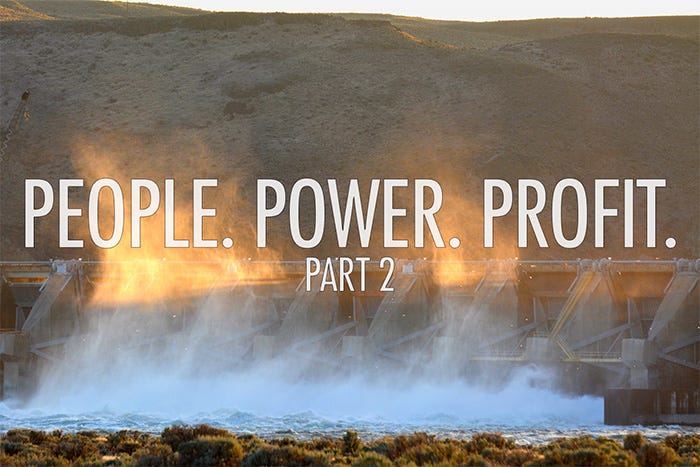
The Floor They Started From — and the Machinery That Protects It
The people driving this lobbying effort to build massive, largely unregulated data centers across our country — Zuckerberg, Bezos, Musk, the leadership of Oracle, NVIDIA, Microsoft, and OpenAI — are without question talented, driven people who built remarkable things. That is not the argument.
The argument is about what they built those things on.
Beneath whatever personal advantages they started with was a public floor. It was built by all of us: the interstate highways, the federal hydroelectric dams, the municipal water systems, the research universities whose federally funded science produced the semiconductors and networking protocols and foundational AI research on which the entire industry rests.
The same principle that brought electricity and running water to rural America through the REAs and the New Deal’s public works programs — the idea that infrastructure too important to leave to market forces belongs to everyone — is the principle that built the economy these men inherited.
Built collectively. Maintained through our shared tax investment. Owned democratically by the people it serves.
Knowing all of this, they have used Citizens United and the Super PACs it unleashed to construct the legal and financial machinery to make sure no one in Washington, D.C. is ever in a position to remind them of it. Ideological architects like Peter Thiel have been essential to that project, funding candidates and political infrastructure that has built the deregulatory ecosystem these industries depend on.
Pro-AI super PACs are planning to spend hundreds of millions of dollars in 2026 supporting candidates who oppose industry regulation. They are targeting the same rural and working-class districts whose residents are watching their utility bills climb and their wells run dry. The people building the data centers on rural communities’ land, drawing down their aquifers, straining their co-op grids, and pricing their families out of their homes are financing the campaigns of the politicians those communities elect to represent them.
That is not a conspiracy theory. It is a financial disclosure.
Why Federal Protection Isn't Coming — and Why the Fight Has Moved to the States
This is the question that should be driving people to their phones, their keyboards, their town halls, and their polling places.
The harm is falling primarily on rural Republican-leaning communities. The states fighting hardest for protection are Idaho, South Dakota, West Virginia, Utah, Kansas, and Minnesota. A 99-1 Senate vote stripped an AI preemption provision from a budget bill — only to have the administration immediately pursue the same preemption through executive orders, defense authorization riders, and new legislation.
Why aren’t the federal representatives of those communities demanding it stop?
Follow the money.
The SHIELD Act has 13 cosponsors. All Democrats. Not one represents the states doing the most to protect their communities at the state level. The same congressional Republicans who represent Kentucky voters turning out data center-supporting incumbents, Georgia ratepayers absorbing six consecutive utility rate increases, and Pennsylvania families watching their electricity bills climb are voting in alignment with the donor class that funds their campaigns rather than the constituents bearing the costs.
The administration is running the same play at the federal level. After the 99-1 Senate vote stripped the AI state preemption provision from the Big Beautiful Bill, the White House AI Action Plan called on federal agencies to limit funding to states with “burdensome” AI laws. House Republicans moved to insert a new preemption provision into the National Defense Authorization Act. The White House drafted an executive order to accomplish by executive action what Congress declined to do by legislation. A new House discussion draft, the Great American Artificial Intelligence Act of 2026, now proposes a three-year freeze on the state laws that are the only meaningful protection many of these communities currently have.
For a look at the disclosed donor picture for the legislators driving the GAAIA, opensecrets.org is the place to start. The industries that have spent the most on lobbying for AI legislation are the same ones that stand to benefit most from federal preemption of state protections. That is where the disclosed money lives. It is worth looking.
But it is only part of the picture. And in the post-Citizens United landscape, it may be the smaller part.
Citizens United didn’t just allow unlimited corporate spending in elections. It opened the door to spending that doesn’t have to be disclosed at all. Shell companies and 501(c) nonprofits are not required to reveal their donors, and in 2024 they funneled $1.3 billion into super PACs through channels that leave no public record. That was more than the prior two election cycles combined.
And it is happening again. Leading the Future, a super PAC backed by Andreessen Horowitz, Palantir co-founder Joe Lonsdale, and other AI industry heavyweights, has pledged to spend at least $100 million in the 2026 midterms specifically to elect lawmakers who will pass federal AI preemption — overriding any restrictions placed on the technology by state governments. The PAC has already raised $125 million.
Demand Progress has launched a public tracker called “AI Money Watch” at aimoneywatch.org, using FEC filings to show voters which midterm candidates the AI industry is buying, which it is trying to stop, and how much it is spending. That is a tool worth bookmarking before November.
The Supreme Court’s majority opinion in Citizens United assumed that robust disclosure rules would accompany unlimited spending. That assumption was wrong. The gap it created is worth addressing. Congress has had multiple opportunities to do so through disclosure legislation. It hasn’t.
The gap between what is disclosed and what is spent is where the most consequential influence lives. Invisible to the voters whose representatives it is purchasing.
That is the context in which AI legislation is being written. It matters when reading what follows.
Some readers will point to the GAAIA as evidence that Washington, D.C. is addressing the problem. I plowed through its 269 pages (note: excellent bedtime reading if you enjoy lying awake staring at the ceiling) and it deserves serious attention. It would establish a federal governance framework for AI with transparency requirements and accountability measures. A section-by-section summary is available at trahan.house.gov, a considerably more readable entry point than the full text. The full discussion draft is linked from the press release at obernolte.house.gov/media/press-releases. Neither requires a sign-up.
But the same bill would freeze state AI laws for three years, stripping states of the ability to regulate how AI models are programmatically developed, while the GAO provision directs the removal of regulations that “unduly burden” the industry. A federal framework that doesn’t yet exist would replace state protections that do. That is a three-year window during which the buildout continues, unchecked.
It is worth pausing here for states' rights advocates, for those who believe in less federal governmental control over state authority, and for anyone across party lines who holds local control as a core political value. The consistent pattern documented in these pages is of federal authority being used, at the direct request of the wealthiest corporations in human history, to strip states of the power to protect their own communities. Every time a barrier is erected, another vehicle is found to drive through it. If limiting federal overreach is a principle you hold, the data center preemption campaign is one of the most direct assaults on that principle currently underway in American politics. It just isn't being covered that way.
There is also a separate claim made in support of both the DATA Act of 2026 and the administration’s voluntary “Ratepayer Protection Pledge” — that requiring data centers to generate their own power protects ratepayers and communities.
Memphis, Tennessee provides one dark answer. What self-generation has meant there, in practice, is unpermitted gas turbines operating without air permits near homes, schools, and churches in a majority-Black community, poisoning air in a city already named an asthma capital of the nation.
When xAI was sued, it responded not by coming into compliance but by adding more unpermitted turbines.
A detailed account of what has happened in Memphis — the NAACP lawsuit, the community’s fight, the tax incentives, and the pattern of environmental racism it represents — is the subject of an accompanying piece published alongside this one. (See: “Memphis and the Price of Someone Else’s Future” at danismart.substack.com.)
State legislators, accountable to actual constituents facing actual local pressure, are passing water disclosure bills, closed-loop cooling requirements, and permit denial authority because their voters are demanding it. Federal legislators, insulated by Super PAC money and safe from primary challenges funded by the same donor class, are not. That gap is not a failure of the system. It is the system working exactly as Citizens United designed it to work.
Meanwhile, the economic pain is being redirected. The donor class has always been skilled at one particular trick: manufacturing a villain that is not them. The economic pain is real. The scapegoat is constructed. Immigrants. The trans community. People of color. Muslims. Whoever is available to absorb the anger that might otherwise be directed at the people routing data centers through rural communities while passing the costs, the environmental damage, and the health consequences to the people who live there. The backlash, when it comes, is bipartisan — because the harm is bipartisan. That is the crack in the wall the donor class did not anticipate — and the public backlash now widening it.
The Other Future
We have spent considerable time in these articles on what’s wrong, who’s responsible, and how the machinery that protects the current arrangement works. That accounting matters. But it is not the whole story. An article that ends only with the indictment misses the most important question: what does the alternative actually look like?
Before going further, one important clarification: I am not asking anyone to abandon frontier AI tools. Frontier AI models are powerful, useful, and increasingly woven into professional and creative work in ways that are genuinely hard to disentangle. That is precisely the point. What I am asking for is something simpler and more achievable: that people recognize they have agency in these decisions. Agency over which tools they use, which companies they support, and whether the choices they make are conscious ones or simply defaults adopted because no one told them the alternatives existed.
It turns out the alternatives already exist. Parts of them are available right now, on the device in your pocket. And understanding them requires first dispensing with a myth that is keeping too many people from engaging with the conversation at all.
“I don’t use AI” has become an odd badge of honor in some quarters. It is almost always said by someone who, that same morning, used a navigation app that rerouted them around traffic, checked a weather forecast generated by machine learning models, or watched a streaming service recommendation built on pattern recognition across hundreds of millions of viewing histories.
A Gallup survey found that 99% of Americans used at least one AI-enabled product in the past week. Nearly two-thirds didn’t realize it.
For nearly everyone participating in modern American economic and civic life, there are no non-users. There is only a gap between people who know they are using AI and people who don’t. That gap is being exploited by the people who profit from keeping the conversation framed as a binary choice between embracing AI unconditionally or rejecting it entirely. It keeps the people most affected by the infrastructure costs from engaging with the actual policy questions, because they’ve opted out of a debate they’ve been told doesn’t concern them.
It concerns all of us. The question was never whether AI. The question has always been who controls it, who profits from it, and who pays for it. The argument here has never been that artificial intelligence is the enemy. It isn't. The enemy is extraction without obligation. The pattern is what is broken, not the technology.
Everything documented in Part One — the SHIELD Act, the water disclosure requirements, the closed-loop cooling mandates, the self-generation debate — is necessary, worth fighting for, and genuinely better than what we have now. But taken together, they are all attempts to manage the consequences of a fundamentally resource-intensive approach to AI infrastructure. Better trash bags for a bigger landfill. The more fundamental demand is optimization of the technology itself.
The resource consumption of current AI systems is not a fixed law of physics. It is an engineering choice made by people optimizing for raw capability and market dominance rather than efficiency. Efficiency costs money upfront, and the people making those choices aren’t the ones paying the water bills or the electricity rates. Parts of the industry are already making different choices. The communities bearing these costs have every right to demand it.
Consider what AI could mean for the small business owner who has historically lacked the accounting departments, HR managers, and compliance officers available only to large corporations. The tools that once required a floor full of people in a downtown tower are becoming accessible to a one-person operation in a small town.
Or the rural doctor where the nearest specialist is three hours away, with pattern recognition across thousands of cases available in real time. Not replacing her judgment. Augmenting it.
Or the tax accountant down the block who knows your family and your business, now able to navigate an ever-changing tax code with the depth of a large firm while keeping the relationship local and human.
That is democratization of capability. The same principle that brought electricity to the family farm.
The numbers make the case plainly. Research published in 2025 found that hybrid edge computing can achieve energy savings of up to 75% and cost reductions exceeding 80% compared to centralized cloud processing. A query to a frontier AI model consumes approximately 33 watt-hours — enough to charge a smartphone. A locally deployed small model consumes 0.001 to 0.01 watt-hours. Roughly 1,000 to 10,000 times less energy, with no data center cooling water required.
The technology for resource-aware, locally deployed AI exists now. Models that run on your phone, your laptop, a small server in a clinic or an accountant’s office, without drawing on a community’s water supply or spiking its electricity bills. Some of those models are already available. You can choose them. But making that choice requires knowing it exists. And knowing it exists requires that someone name the alternative: the centralized extractive model is a choice, not a necessity.
What is required is that the 99% reclaim agency over what has been built on their backs. The society that purchases the products, uses the services, and generates the data on which AI systems are trained is the same society now being told it cannot afford the electricity that powers them.
That is not an accident. It is a choice. And choices can be unmade.
The American Dream was never a promise that a few people would get extraordinarily rich. It was a promise that the society built by all of us would be livable for all of us. That the work of building it would be rewarded. That the next generation would have more options than the last, not fewer.
We are not required to sunset that promise to power someone else’s data center.
Smart Ruminations is 100% subscriber-supported. No advertisers. No institutional funding. No donor class to answer to. Only you.
For four years I’ve written about the gap between the America we were promised and the one being built around us. If it’s the kind of analysis you want to exist in the world: factual, non-tribal, willing to follow an argument wherever the evidence leads regardless of whose politics it complicates, I’d be grateful for your support.
Paid subscriptions are just $5 a month. Every dollar goes directly toward the research and writing that makes pieces like this one possible. I mean it when I say that your support means the world to me. It’s what allows me to keep doing this work independently, on my own terms, accountable only to the readers who make it worth doing.
For a limited time, new paid subscribers receive 10% off.
And Now the Nerdy Stuff. A Brief Glossary — and Where to Start
The argument in “The Other Future” section depends on some technical concepts that deserve plain-language definitions, as well as some specific tools you can actually use today. Neither requires a computer science degree.
Frontier AI Model: The most powerful and capable AI systems currently in existence — the kind built and operated by OpenAI, Anthropic, Google DeepMind, Meta, and a handful of others. The term refers to models at the cutting edge of what the technology can do: broad general capability, enormous scale, trained at costs of tens or hundreds of millions of dollars.
In regulatory terms, a frontier model is typically defined as one trained using more than 10²⁶ FLOP (floating point operations — yes, it's a deeply nerdy unit of measurement, but worth knowing or at least trotting out on trivia night) at a cost exceeding $100 million. Only a handful of organizations in the world have the resources to build them. The GAAIA's transparency requirements and accountability measures apply specifically to "large frontier developers" — meaning the biggest players. Smaller developers, open-source projects, and locally deployed models are treated differently, which is both a feature and a potential loophole worth watching.
Large Language Model (LLM): The kind of AI most people have encountered through ChatGPT, Claude, or Google Gemini. These are trained on enormous amounts of data, require massive computing infrastructure to run, and process your queries through distant data centers consuming significant electricity and water. When you type a question into ChatGPT, your words travel to a server farm, are processed there, and the answer travels back. The data center runs regardless of whether you’re using it.
Small Language Model (SLM): A more compact, efficient version of an AI model that can run directly on your own device — your laptop, your phone, or a small local server — without sending your data anywhere. Small language models are compact, efficient, and don't need massive servers. They're built for speed and real-time performance and can run on smartphones, tablets, or laptops. They use a fraction of the energy of their large counterparts and generate no data center water consumption for your queries.
You might reasonably ask why, if these models exist, you haven't heard more about them. The answer is straightforward: the business model of the companies that dominate AI depends on you routing your queries through their infrastructure. Every time you use a centralized AI service, you are generating data, consuming computing power billed to you directly or through subscriptions, and feeding a system that requires the kind of hyperscale infrastructure documented in Part One of this series. A locally deployed model running on your own device generates none of that revenue. Which is not a reason to avoid frontier models — it is a reason to understand what you are choosing when you use them, and to know that the choice exists.
Edge Computing: Processing data locally, at the “edge” of the network — meaning on your device or a nearby server — rather than routing it to a centralized data center. Edge AI is the model that allows the rural doctor’s diagnostic tool, the small business owner’s accounting assistant, or the tax accountant’s research aid to function without depending on hyperscale infrastructure.
Hyperscale Data Center: A facility of the kind documented in Part One of this series — hundreds of thousands of square feet, consuming the power of 100,000 homes, drawing millions of gallons of water daily. These are the facilities whose infrastructure costs are being shifted onto ratepayers and whose construction is straining rural communities across America.
Closed-Loop Cooling: A water cooling system that recirculates water rather than consuming it through evaporation. The difference between open-loop and closed-loop cooling is the difference between a facility that draws down an aquifer and one that uses the same water repeatedly. Several states are now requiring closed-loop systems for new data center permits.
Open-Weight Model: An AI model whose underlying parameters are publicly released, allowing anyone to download, run, and modify it. This is the category of models that enables local deployment — because the model itself can live on your device rather than on a corporation’s server.
Models Worth Knowing
These are specific, publicly available AI models that run locally on consumer hardware — on your laptop or phone — without sending your data to a distant data center. All are free to download and use. None require technical expertise beyond following installation instructions.
Ollama (ollama.com) — Not a model itself, but the easiest way to run local models on a Mac, Windows, or Linux computer. Think of it as the app store for local AI. Free, open source, and genuinely simple to use. Start here.
Meta Llama 3.2 — Best for edge and mobile deployment. Runs on consumer hardware with 8GB of RAM. General purpose: writing, summarizing, answering questions, drafting emails. Available through Ollama with a single command.
Microsoft Phi-4-mini — Runs comfortably on an M1 MacBook Air or entry-level laptop. Handles code completion, simple explanations, and lightweight conversation. Particularly good for focused tasks. Microsoft’s smallest and most efficient model.
Google Gemma 3 — Optimized for deployment on laptops, desktops, or private clouds. Strong benchmark scores for summarization, question answering, and reasoning. Good for small business applications. Available through Ollama.
Mistral 7B — Outperforms larger models while requiring significantly fewer resources. Strong multilingual performance and an open license that makes it suitable for commercial use. A good choice for small businesses with multilingual needs.
LM Studio (lmstudio.ai) — An alternative to Ollama with a more visual interface, easier model browsing, and side-by-side comparison tools. Good for readers who prefer not to use a command line. Free for personal use.
These models are not as capable as the largest frontier systems for complex tasks. They are more than capable for the everyday uses that constitute most AI interaction: drafting, summarizing, answering questions, analyzing documents, assisting with research. And they do all of it on your device, with your data, at a fraction of the energy cost — and none of the water.
That is the choice. Now you know it exists.
One more note on choice — for readers not ready to go local:
If running a local model feels like a step too far right now, there is still a choice worth making within the centralized AI landscape: which company’s values you are supporting when you use their service.
Not all AI companies are the same in their stated commitments, their corporate structure, or their relationship to the missions they were founded on. OpenAI began as a nonprofit dedicated to ensuring AI benefits humanity. Its conversion to a capped-profit structure, and the ongoing legal dispute with Elon Musk — who sued OpenAI arguing it had abandoned its founding mission — is publicly documented and worth reading about before deciding where to put your usage and, if applicable, your subscription dollars. Anthropic was founded by former OpenAI researchers who left over safety disagreements, has published a Responsible Scaling Policy committing to specific safety thresholds before deploying more powerful models, and maintains a governance structure designed to resist the kind of mission drift its founders witnessed. Google’s Gemini, Meta’s Llama, and Microsoft’s Copilot each have their own governance models, corporate incentives, and public commitments — or lack thereof — worth examining.
This is not a recommendation of any specific product. It is an observation that in a market where your data, your usage, and your subscription fees all feed back into the development of systems that will shape the economy documented in this series, informed choice is itself a form of democratic agency.
The companies are not all the same. The differences are worth knowing. A good place to start: each company publishes its safety and governance commitments publicly. Reading them side by side takes about an hour and tells you a great deal about where their priorities actually lie.
Smart Ruminations publishes cross-partisan, non-tribal analysis of American political economy. Part One of this series — “The Next Extraction: How AI Data Centers Are the Latest Version of an Old Con” — is available at danismart.substack.com. The accompanying piece on Memphis and environmental justice, “Memphis and the Price of Someone Else’s Future,” is also available at danismart.substack.com.
Smart Ruminations is 100% subscriber-supported. No advertisers. No institutional funding. No donor class to answer to. Only you.
For four years I’ve written about the gap between the America we were promised and the one being built around us. If it’s the kind of analysis you want to exist in the world: factual, non-tribal, willing to follow an argument wherever the evidence leads regardless of whose politics it complicates, I’d be grateful for your support.
Paid subscriptions are just $5 a month. Every dollar goes directly toward the research and writing that makes pieces like this one possible. I mean it when I say that your support means the world to me. It’s what allows me to keep doing this work independently, on my own terms, accountable only to the readers who make it worth doing.
For a limited time, new paid subscribers receive 10% off.
An excellent survey of the problem -- and a useful overview of possible, realistic solutions.