
The Stimulus We Keep Refusing: Why Universal Healthcare Would Unleash the American Economy
We’ve spent decades debating what universal healthcare would cost. We’ve barely begun to reckon with what we lose by not having it.

A universal healthcare system in the United States would:
Unlock entrepreneurship by ending job lock, freeing millions of workers to start businesses, change careers, and move to where their skills do the most good — and freeing corporations from a captive workforce that stays for benefits, not performance.
Level the playing field for small business by removing healthcare as a competitive disadvantage against large employers.
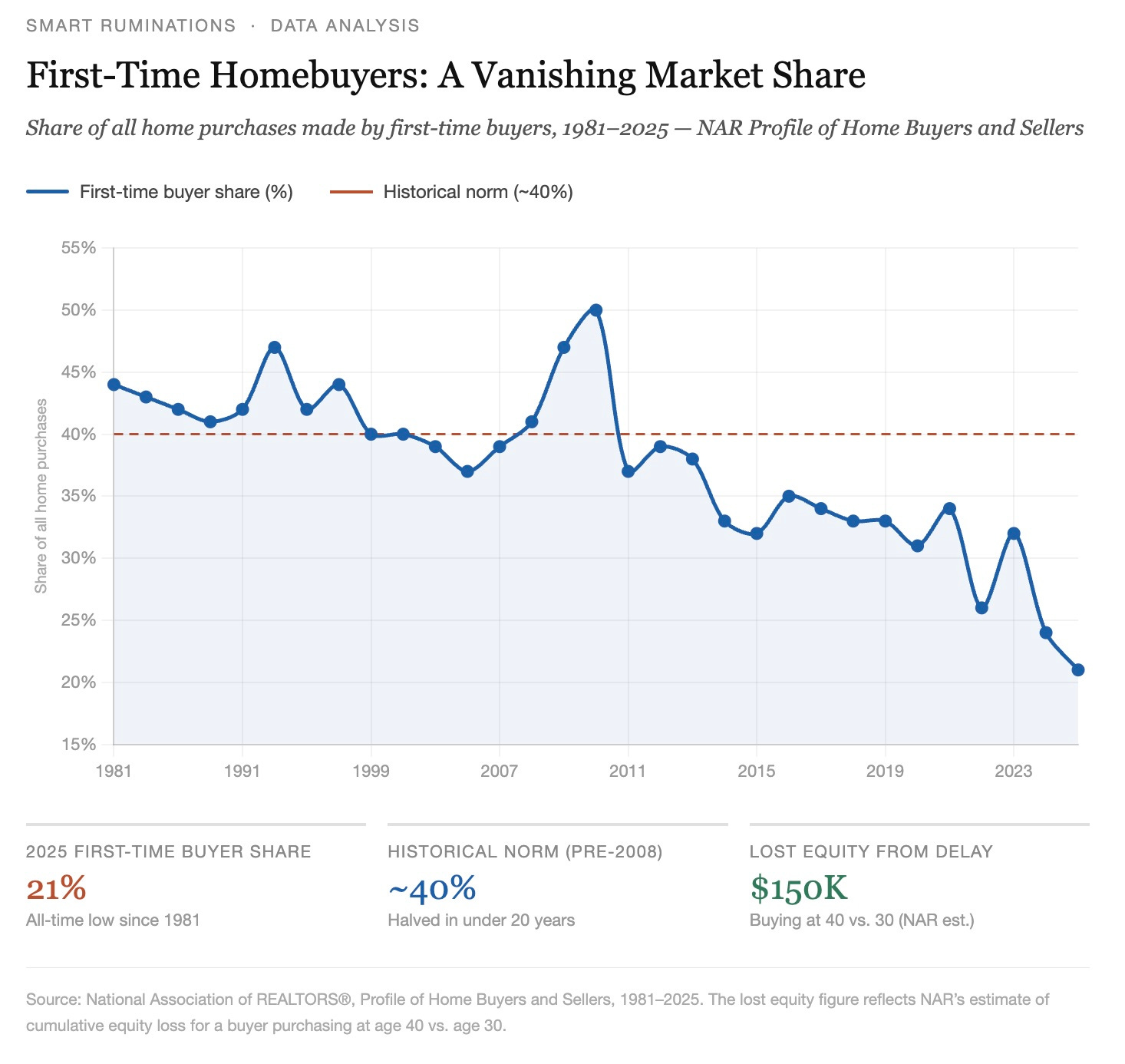
Restore homeownership by addressing the hidden healthcare cost drag that has helped cut the first-time buyer share from 40% to a record low 21%, and costs delayed buyers an estimated $150,000 in lost lifetime equity.
Return $125,340 in lost wages to the average American family over time, compensation that has been quietly redirected to insurers instead of paychecks, dollar by dollar, year by year.
Open the door to behavioral healthcare for millions of children and families currently priced out of diagnosis, treatment, and in-patient care, where insurance isn’t just helpful, it is the admission ticket.
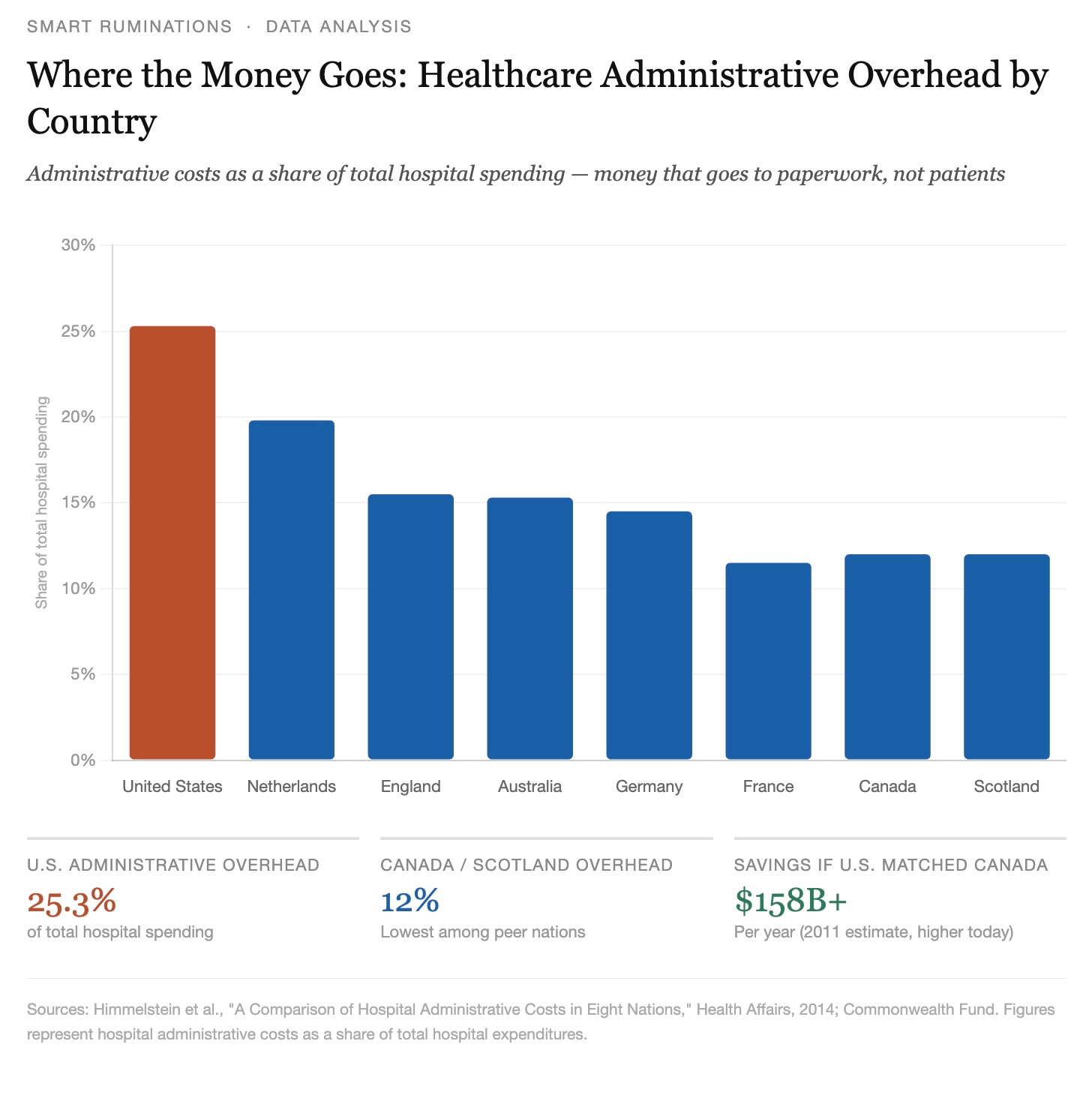
Cut administrative waste by hundreds of billions annually, redirecting money from billing departments and prior authorizations back to patients.
Reduce the total financial burden on middle-class families, who currently pay more than their counterparts in France or Germany when taxes and private healthcare, childcare, and elder care costs are combined.
Free large employers from a cost no competitor nation places on its businesses, improving productivity, reducing absenteeism, and ending the captive workforce problem.
Americans like to believe we have the best healthcare in the world. The reality is harsher: we have the most expensive system among developed nations, and some of the worst outcomes. In 2023, the total cost of healthcare in America ran roughly $13,400 per person, more than twice the per-person cost in other wealthy countries.
That figure includes what individuals pay, what employers pay, and what government programs cover. We rank last in life expectancy, maternal mortality, and preventable deaths among our peers. We pay more, live less, and millions remain uninsured or underinsured.
The reason isn’t inefficiency. It’s intent. The system isn’t built to keep people healthy. It’s built to keep shareholders profitable.
The debate we’ve been having for decades is the wrong one. We’ve framed universal healthcare as a cost: a massive new government expenditure, a burden on taxpayers, a socialist intrusion into the free market. What we haven’t done is ask the other side of the ledger: what is our current system costing us? Not in moral terms, though those matter. In hard economic ones. The answer is: a great deal.
The numbers tell a story that transcends politics. Since 1999, total family health insurance premiums have risen 342%. Over that same period, nominal wages roughly doubled, but adjusted for inflation, the real purchasing power of American workers grew by as little as 11%. Premiums didn’t just outpace wages. They lapped them.
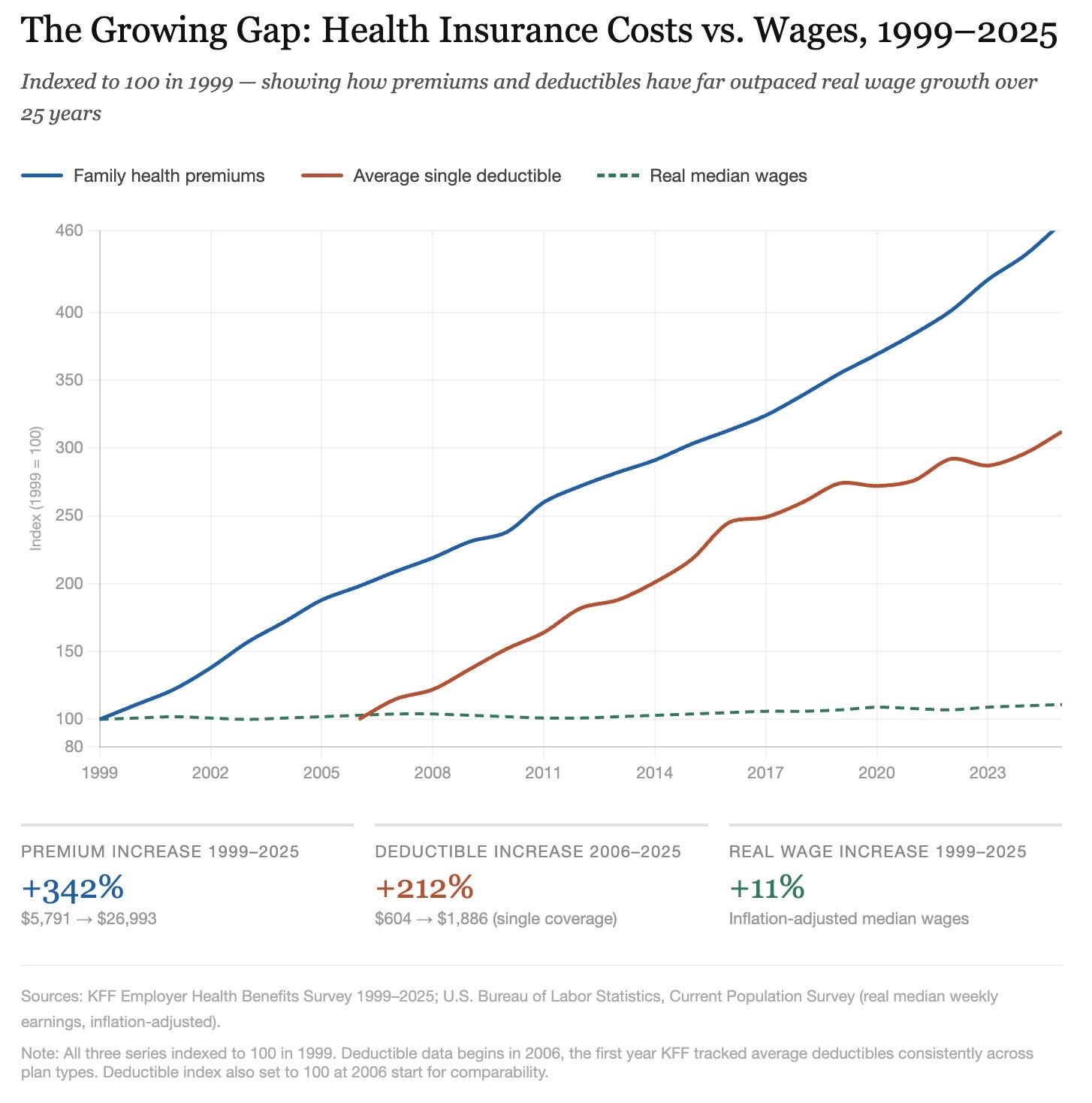
The average family plan now costs nearly $27,000 a year in premiums alone. We hear that this is a problem for people without employer-sponsored coverage. The data says otherwise.
What employers call “benefits” are, in economic terms, wages paid to someone other than the worker. Every dollar an employer spends on health insurance premiums is a dollar of compensation that never reaches a paycheck. Workers don’t negotiate it, can’t spend it, and often can’t even see it. It flows directly from employer to insurer, invisible in the transaction but very real in its effect on take-home pay. The “benefit” isn’t free. The worker pays for it in the salary they were never offered.
Employers have used those same rising premium costs as cover to hold wages down. For small businesses, that may be a matter of survival. For large corporations, it has too often meant protecting executive compensation and shareholder returns before workers’ paychecks.
A JAMA study tracking 25 years of data estimated that premium growth cost the average American family $125,340 in lost earnings between 1988 and 2019 — not in a single year, but accumulated over that period. That’s compensation earned and quietly redirected to insurers, dollar by dollar, year by year.
That’s not money the uninsured lost. That’s money workers with employer coverage lost, quietly, invisibly, in the gap between what their labor was worth and what their paychecks reflected. Rising healthcare costs don’t just price people out of insurance. They suppress the paychecks of people who have it.
My husband and I left corporate America in 2001. I came from The Seattle Times; he came from an international music company. We walked straight into that trap. We had five children and were told, repeatedly, that allowing our family to go uninsured was socially irresponsible, perhaps even morally so.
So we bought into COBRA coverage at considerable expense. COBRA also taught me something my paychecks never had: what my benefits had actually cost. For the first time, I could see the full premium: the portion I had contributed and the far larger portion my employer had paid on my behalf. That was compensation I had earned and never seen, flowing directly from employer to insurer, invisible until the moment I had to write the check myself.
It tied us to the corporate insurance system for years, paying premiums that had nothing to do with our actual health and everything to do with a market that had no obligation to negotiate for us.
The Idea That Came From the Right
In 1989, as momentum for a national healthcare system was growing, the conservative Heritage Foundation, longtime champions of private market solutions, moved to define the debate on its own terms, proposing an individual mandate requiring all Americans to purchase insurance from private companies, paired with premium tax credits for lower-income households.
The same individual mandate and premium tax credits that would later be denounced as socialist hallmarks of Obamacare originated not with Democrats, but with the right’s own premier policy institution. That idea became the ACA’s backbone.
The private insurance industry’s role was secured, not because it produced better outcomes, but because it produced better profits. The mandate was never to heal. It was to sell.
The ACA didn't cause today's crisis. Costs were rising fast for decades before 2010, driven not by greedy doctors, but by hospital consolidation born of the same privatization wave that sold off community infrastructure across American public life in the 1980s and 1990s, pharmaceutical pricing power, and layers of administrative overhead that exist nowhere else in the developed world. No single actor was controlling prices because no single actor had the power or the incentive to. That's precisely what a universal system changes. A single-payer or tightly regulated multi-payer system negotiates prices the way no private insurer ever can, on behalf of everyone, with the leverage of the entire market behind it.
What the Debate Gets Wrong
“Universal healthcare is socialism.” Some have escalated further, calling it communism. France, Germany, Japan, and the Netherlands are capitalist democracies with thriving private sectors. They might be surprised to hear it. In all four countries, doctors and hospitals remain privately run, markets function, and property rights are intact. What’s universal isn’t ownership. It’s access.
The label isn’t a policy argument. It’s a conversation-stopper, and it has been remarkably effective at one thing: keeping Americans from asking whether the system they have is actually working for them.
There is already a universal, government-run healthcare system operating in the United States. It covers roughly 9.5 million people: active duty military, veterans, and their families. It has been running for decades. The VA and the Military Health System are not experiments. They are institutions.
When politicians have attempted to privatize them, the veterans who depend on them have fought back. Not because they are ideologically committed to government healthcare, but because it works and they don’t want to lose it. The largest single-payer system in America is the one we built for the people who serve it.
Nobody calls it communism.
Research shows military children have higher rates of diagnosed special health care needs and behavioral health conditions than their civilian counterparts. That finding is sometimes cited as a strike against the military system. It may actually be evidence for it. A child whose family has consistent, comprehensive coverage gets diagnosed and treated. A civilian child whose family cannot afford the specialist or the in-patient facility never does. They don’t appear in the data as having a need. They just go untreated.
According to a Health Policy Institute of Ohio study, nearly half of children cannot access mental healthcare because their insurance is not accepted by providers. The self-pay rate for outpatient mental health care runs twenty times higher than for other outpatient medical care. For inpatient behavioral health, the highest-need and highest-cost intervention, insurance isn’t just helpful. In much of the country, it is the admission ticket.
“Government care means bureaucrats deciding your treatment.” Private insurers already make life-or-death decisions. The actual death panel is already operating: patients needing organ transplants must prove the ability to pay for surgery, post-op care, and lifelong anti-rejection medications. Nearly 48% of adult heart transplant centers require proof of insurance before evaluation. More than 5,600 people die annually waiting for organs because they cannot afford to qualify. That’s not hypothetical rationing. That’s the system we have.
“Universal systems mean long waits.” The U.S. already rations care by cost. Millions delay or forgo treatment every year not because of a government queue, but because they can’t afford to go. Average primary-care wait times in the U.S. run roughly three weeks, longer than the UK and Italy at ten days, longer than France at six days, longer than Switzerland at two. The American with solid insurance is already waiting longer than the average patient in a universal system.
“It will raise taxes.” But the comparison that matters isn’t taxes alone. It’s total financial burden. The U.S. tax-to-GDP ratio sits at roughly 27%, below France at 43% and Germany at 37%. Add in what households pay privately for healthcare, childcare, and pre-K, costs covered within those higher tax rates in peer nations, and the picture reverses completely.
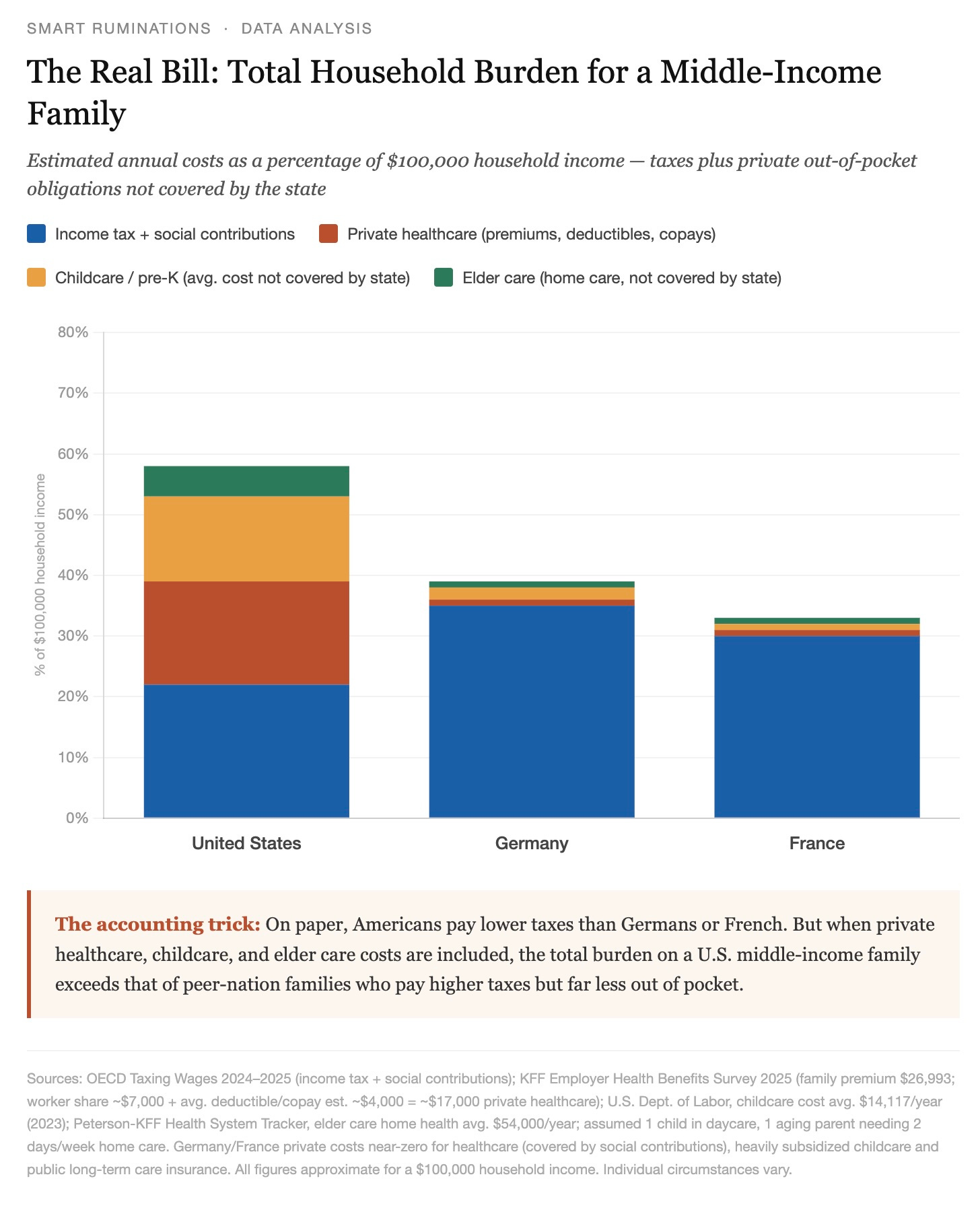
A middle-income family in Germany or France pays higher taxes and then is largely done. A comparable American family writes a second check for healthcare, a third for childcare, a fourth for pre-K. And when parents age, a fifth: elder care that runs $4,500 a month or more for home care alone, in a country where no universal long-term care system exists to absorb it. Germany has had mandatory public long-term care insurance since 1995. The U.S. has Medicaid, which requires most people to spend down nearly everything they own before qualifying.
For the wealthy, those checks are an inconvenience. For working and middle-class families, they are the difference between building a life and treading water. The lower tax rate is not a savings. It is an accounting trick that moves the cost from a government line item to a household budget, and then asks the household to manage it alone.
Entrepreneurship and Job Lock
Ask any economist about the conditions that produce a dynamic economy and they’ll give you some version of the same list: educated workforce, robust infrastructure, access to capital, and labor mobility. People need to be able to move where their skills are most productive, leave jobs that don’t suit them, start businesses, take risks. Our healthcare system systematically destroys labor mobility.
The phenomenon even has a name: “job lock.” Studies consistently show that a significant share of American workers stay in jobs they would otherwise leave specifically because they cannot afford to lose employer-sponsored insurance. They don’t start that business. They don’t take the lower-paying job that leads somewhere better. They stay put. It is a structural drag on the single most valuable input in the modern economy: human talent deployed where it can do the most good.
The next great wave of American entrepreneurship may be waiting on the other side of a universal coverage card.
The Small Business Equation
Here’s a paradox at the heart of American economic mythology: we celebrate small business as the engine of job creation, and then saddle small businesses with a cost structure that large corporations can absorb and they cannot. A company with 50,000 employees negotiates insurance rates across a massive risk pool. A plumber starting her own shop, a restaurant owner, a freelance designer: they face either going uninsured or buying expensive individual coverage.
This disparity rarely gets fixed by legislation, even when legislators say it will. The promise of small business protections is a fixture of nearly every major healthcare debate. So is the quiet reality that follows: the final bill reflects the priorities of the lobbyists who helped write it, and those lobbyists represent large employers, not sole proprietors. The thresholds protect corporations and burden the businesses trying to grow past them. The small business owner is left navigating a system that was never designed with her in mind.
Countries with universal systems have cut through this entirely by socializing the fixed cost of healthcare. Every business, whether a sole proprietorship or a Fortune 500 company, competes on labor, innovation, and execution. Not on who can afford better benefits. The playing field is level in a way American healthcare policy has promised and never delivered.
The most pro-small business policy America could adopt isn’t a tax cut. It’s removing healthcare from the cost of doing business entirely.
The Hidden Mortgage
The first-time homebuyer is disappearing from the American market. According to the National Association of Realtors, first-time buyers now make up just 21% of all home purchases, an all-time low since NAR began tracking in 1981. Before the Great Recession, the norm was roughly 40%. The share has been cut nearly in half in under twenty years. And for those who do manage to buy, the financial cost of waiting is steep. NAR estimates that buying at 40 instead of 30 costs a typical buyer roughly $150,000 in lost equity over their lifetime.
This is not a failure of thrift or personal responsibility. It is a cash-flow crisis, and our healthcare system is a significant driver.
Mortgage approvals depend on many factors, but none is more consequential for working families than the debt-to-income ratio. When premiums rise, take-home pay stagnates, suppressing income while high deductibles force families into medical debt.
The system simultaneously lowers earnings and raises debt loads, pushing millions of otherwise qualified buyers above the DTI threshold and into mortgage denial. Monthly premiums don't appear on a credit report, but any lender building a post-closing budget knows they're there. A single medical emergency can divert mortgage payments overnight. The system doesn't just delay homeownership. It makes it a dangerous gamble.
The next great unlock for American homeownership isn't a new loan program or a zoning reform. It's a healthcare system that stops eating the down payment and returns wage growth to the workers who earn it.
The 40-year-old first-time homebuyer was always meant to be 29. We can get back there. But not until we fix this.
The Cost of Extraction and Who Pays It
There’s a reason nothing has changed: a small number of people are making an extraordinary amount of money from the way things are. From 2001 to 2022, the healthcare industry returned $2.6 trillion to shareholders through dividends and buybacks. The CEOs of the six largest national health plans collectively earned over $159 million in recent compensation. There is a captive population, a political influence machine, and very little incentive to change.
The U.S. spends roughly 17% of GDP on healthcare. Most peer nations spend 10-12%. Administrative overhead runs at nearly 35% of U.S. healthcare spending, compared to roughly 12% in Canada. That gap is money that does not go toward care. It goes toward billing departments, prior authorizations, and the armies of people whose entire job is paperwork. It goes to shareholders. It goes to executive compensation. It does not go to patients.
The people with the most power to change this have the least reason to. Members of Congress receive comprehensive health coverage, fully subsidized by taxpayers. They have never had to choose between a prescription and groceries, between a specialist visit and the mortgage payment. Whatever they experienced before taking office, the moment they were sworn in, healthcare became the least of their concerns. That's precisely when their power to fix it began.
A Workable Path Forward
The solution isn’t to eliminate private insurance, and it isn’t free healthcare. It’s to recognize that healthcare is a public good, not a commodity, paid for collectively the way roads and schools are paid for: through taxes, spread across everyone who uses them.
The Bismarck Model, used in Germany and the Netherlands, preserves a role for private insurers under strict public oversight and universal access requirements. Two structural changes make it work: insurers providing essential coverage operate as nonprofits or face strict caps on administrative spending and profit margins; national boards set standard prices for medical services.
In the United States, the reason the same MRI costs $2,000 in one city and $20,000 in another is that nobody is stopping it.
And Now It’s Getting Worse
On July 4, 2025, President Trump signed the One Big Beautiful Bill Act into law. The nonpartisan CBO estimates it will cut federal Medicaid spending by more than $1 trillion over ten years, eliminating coverage for an estimated 11.8 million people, with millions more losing ACA marketplace coverage as enhanced premium tax credits expire.
The burden falls hardest on the self-employed. Roughly 16 million Americans who file 1099s and purchase insurance through the ACA marketplace have no employer to verify hours, no supervisor to sign off on anything. That’s the entire legal architecture of independent contractor status. The work requirement written into the OBBBA doesn’t account for that reality. When I raised this with Representative Dan Newhouse, he called it an “unintended consequence” and then voted yes anyway.
Unintended, perhaps. Avoidable, certainly. And now law.
For those who remain on the Exchange, the plan itself has become a moving target. When the premium for a Gold plan reaches $2,400 a month, families don’t choose to downgrade to Bronze. They get priced into it: higher deductibles, more exposure, less protection, while still paying thousands annually just to have the card in their wallet.
It wasn’t always this difficult to navigate. Before the ACA, small business owners buying on the open market had almost no options. The early ACA changed that. For a time, the promise of coverage felt real. Over time, options dwindled, denials multiplied, and I learned to navigate the system in ways no patient should have to, including asking doctors not to co-sign records when we had intentionally seen a Nurse Practitioner or PA to manage costs, knowing a physician sign-off would trigger a billing tier with no additional medical benefit. I became fluent in a language of appeals, authorizations, and workarounds that exists solely because the system is designed to delay and deny rather than to cover and care.
I learned to ask a question no patient should ever have to ask: is this treatment necessary because my insurance says it’s necessary, or because it’s necessary for my health? In a system designed around profit, those are not always the same answer. Few medical professionals could answer that question. Most walked me down to the billing department instead. That told me everything I needed to know about where the system’s priorities actually lived.
The very tools the Heritage Foundation originally proposed, the individual mandate and premium tax credits, have been systematically dismantled. What remains is a for-profit industry with less competition, less accountability, and less responsiveness to the country’s actual health needs than at any point since the ACA passed. We are not watching a system fail. We are watching it perform exactly as it was designed to.
If you believe in free markets, you should be troubled by a labor market where workers can’t freely move to their most productive use. If you believe in small business, you should be troubled by a cost structure that systematically advantages large employers. If you believe in fiscal responsibility, you should be troubled by a system that spends more than any other wealthy nation and gets less for it than any of our peers.
And if you run a large company, the math is worth doing. Universal healthcare would remove healthcare costs from the employer’s balance sheet entirely, freeing billions in compensation budgets currently flowing to insurers. It would end job lock, giving corporations access to a fully mobile, fully voluntary workforce, people who stay because the work is good, not because they can’t afford to leave. It would reduce absenteeism, improve productivity, and eliminate the administrative burden of managing benefits for thousands of employees. Every major competitor nation has figured this out. American corporations are the last large employers in the developed world still carrying this cost alone.
The tax argument deserves one final word: Americans are already paying. Not in one line item, but across four or five separate bills — premiums, deductibles, childcare, elder care — each covering something a higher tax rate absorbs elsewhere. The math has already been done. The answer keeps coming out the same.
And let's be clear about what universal healthcare actually is. It is not free healthcare. It is not socialism. It is not communism. It is healthcare paid for through taxes, the same way roads and schools are. The argument for universal coverage is not that Americans want something for nothing. It is that Americans are already paying enough to have something, and a system built around profit has been quietly pocketing the difference.
The question isn’t whether we can afford universal healthcare. The harder, more honest question is whether we can afford to keep not having it. Every day, Americans die of preventable illnesses. Families choose between insulin and rent. Small businesses close because the owner couldn’t afford to get sick.
We already pay enough. What’s missing isn’t money. It’s the political will to stop letting a small number of people profit from everyone else’s pain.
Smart Ruminations is 100% subscriber-supported. No advertisers. No institutional funding. No donor class to answer to. Only you.
For four years I’ve written about the gap between the America we were promised and the one being built around us. If it’s the kind of analysis you want to exist in the world: factual, non-tribal, willing to follow an argument wherever the evidence leads regardless of whose politics it complicates, I’d be grateful for your support.
Paid subscriptions are just $5 a month. Every dollar goes directly toward the research and writing that makes pieces like this one possible. I mean it when I say that your support means the world to me. It’s what allows me to keep doing this work independently, on my own terms, accountable only to the readers who make it all worth while.
For a limited time, new paid subscribers receive 10% off.
References & Further Reading
Health Spending & Cost Comparisons
Peterson-KFF Health System Tracker. “How Does Health Spending in the U.S. Compare to Other Countries?” Updated March 2026. https://www.healthsystemtracker.org/chart-collection/health-spending-u-s-compare-countries/
KFF. “2025 Employer Health Benefits Survey.” October 2025. https://www.kff.org/health-costs/report/2025-employer-health-benefits-survey/
Commonwealth Fund. “Mirror, Mirror 2024: A Portrait of the Failing U.S. Health System.” September 2024. https://www.commonwealthfund.org/publications/fund-reports/2024/sep/mirror-mirror-2024
Wage Suppression & Lost Earnings
Himmelstein, David U., et al. “Health Care Administrative Costs in the United States and Canada, 2017.” Annals of Internal Medicine, 2020. https://www.acpjournals.org/doi/10.7326/M19-2818
Himmelstein, David U., et al. “A Comparison of Hospital Administrative Costs in Eight Nations: U.S. Costs Exceed All Others by Far.” Health Affairs, 2014. https://www.healthaffairs.org/doi/10.1377/hlthaff.2013.1327
Dieleman, Joseph L., et al. “Factors Associated With Increases in US Health Care Spending, 1996–2013.” JAMA, 2017. (Source for $125,340 cumulative lost earnings figure.) https://pubmed.ncbi.nlm.nih.gov/29114831/
Homeownership & First-Time Buyers
National Association of Realtors. “First-Time Home Buyer Share Falls to Historic Low of 21%, Median Age Rises to 40.” November 2025. https://www.nar.realtor/press-releases/first-time-home-buyer-share-falls-to-historic-low-of-21-median-age-rises-to-40
National Association of Realtors. “Profile of a First-Time Home Buyer.” 2025. https://www.nar.realtor/infographics/profile-of-a-first-time-home-buyer
Tax Burden Comparisons
OECD. “Taxing Wages 2025.” April 2025. https://www.oecd.org/en/publications/2025/04/taxing-wages-2025_20d1a01d.html
FiscalFold. “US vs Europe: Who Really Pays More in Taxes?” 2026. https://www.fiscalfold.com/blog/us-vs-europe-taxes/
Hospital Privatization & Rural Closures
Chartis Center for Rural Health. “Rural Hospital Closures: A New Understanding of the Landscape.” 2024. https://www.chartis.com/insights/rural-hospital-closures-new-understanding-landscape
Commonwealth Fund. “A Comparison of Hospital Administrative Costs in Eight Nations.” 2014. https://www.commonwealthfund.org/publications/journal-article/2014/sep/comparison-hospital-administrative-costs-eight-nations-us
Behavioral Health Access
Health Policy Institute of Ohio. “Behavioral Health Access in Ohio.” 2025.
https://www.healthpolicyohio.org
Center for American Progress. “The Behavioral Health Care Affordability Problem.” May 2022. https://www.americanprogress.org/article/the-behavioral-health-care-affordability-problem/
Military Healthcare
Military Times. “Military Children Have More Health Care Needs, But Less Access and Lower Quality, Study Finds.” August 2019. https://www.militarytimes.com/pay-benefits/2019/08/05/military-children-have-more-health-care-needs-but-less-access-and-lower-quality-study-finds/
The Heritage Foundation & ACA History
Butler, Stuart M. “Assuring Affordable Health Care for All Americans.” The Heritage Foundation, October 1989. https://www.heritage.org/social-security/report/assuring-affordable-health-care-all-americans
The One Big Beautiful Bill Act & OBBBA
Congressional Budget Office. “Budgetary Effects of the One Big Beautiful Bill Act.” July 2025. https://www.cbo.gov
Organ Transplant Rationing
Kilic, Arman, et al. “Health Insurance as a Requirement to Undergo Cardiac Transplantation: A National Survey of Transplant Program Practices.” Journal of Heart and Lung Transplantation, 2013. (Source for 48% of heart transplant centers requiring proof of insurance before evaluation.) https://pubmed.ncbi.nlm.nih.gov/23267807/
KFF Health News. “No Cash, No Heart. Transplant Centers Require Proof of Payment.” December 2018. https://kffhealthnews.org/news/no-cash-no-heart-transplant-centers-require-proof-of-payment/
Elder Care
Peterson-KFF Health System Tracker. “What Drives Health Spending in the U.S. Compared to Other Countries?” October 2024. https://www.healthsystemtracker.org/brief/what-drives-health-spending-in-the-u-s-compared-to-other-countries/
Genworth. “Cost of Care Survey 2024.” https://www.genworth.com/aging-and-you/finances/cost-of-care.html
Your comment about the requirement to show hospitals how you will pay for care up front before treatments could start brought tears to my eyes. I flashed back to the early 1990's when we sat in a financial services office at Fred Hutchinson. We had to explain how my parents would sell some of their artwork and we would put on a pancake feed at the church to raise the money for my brother's $250,000 bone marrow transplant. It was an excruciating conversation. My brother had stage 4 cancer. Time was of the essence. All they seemed to care about was how they would get their money. He was in his early 20's at the time. He did receive the bone marrow transplant and the treatments that followed. He died a month after his 23rd birthday. I'm not blaming Fred Hutchinson for his death. They treated him so well but the trauma they caused us in that room has never gone away.
Thank you for your thoughtful, well-researched piece. I’m sharing widely, and hoping others will read and understand!!!