
They Already Built the Model
How Rural Co-ops Invented Energy Independence Long Before It Was a Political Slogan

Whatever your politics, I hope you’ll stick with me on this. We’re all feeling the pain right now at the grocery store, at the gas pump, and in our healthcare premiums, and it doesn’t matter how anyone voted. What I want to talk about is energy. Specifically, who gets to own it and who gets to profit from it. Somewhere along the way that conversation got turned into a cultural signal. A team jersey. And once that happened, a lot of people who stood to benefit the most stopped listening.
Even though times are hard, there's an opportunity hiding in broad daylight, forged in rural America generations ago and quietly adopted in our cities and college towns too, often without anyone realizing they were drawing from the same well.
I hope you'll take a moment and set the jersey aside. What follows is a story about where we've been, why the current conversation is failing us, and what a different one could look like.
A Century of Working Together
There is a name on power lines across rural America that most people stopped noticing decades ago. A cooperative. A name ending in “Electric” or “Power” that doesn’t match any of the big utility holding companies headquartered in distant cities. Farmers strung those lines themselves, or their grandparents did. They pooled money they didn’t have much of, formed boards, elected neighbors, and brought electricity to places the private market had decided weren’t worth the wire.
That wasn’t independence. It was the fight for inclusion. Electricity was already remaking how Americans lived, worked, and produced. The farmers who built their own lines weren’t asking permission to join that future. They were refusing to be left out of it.
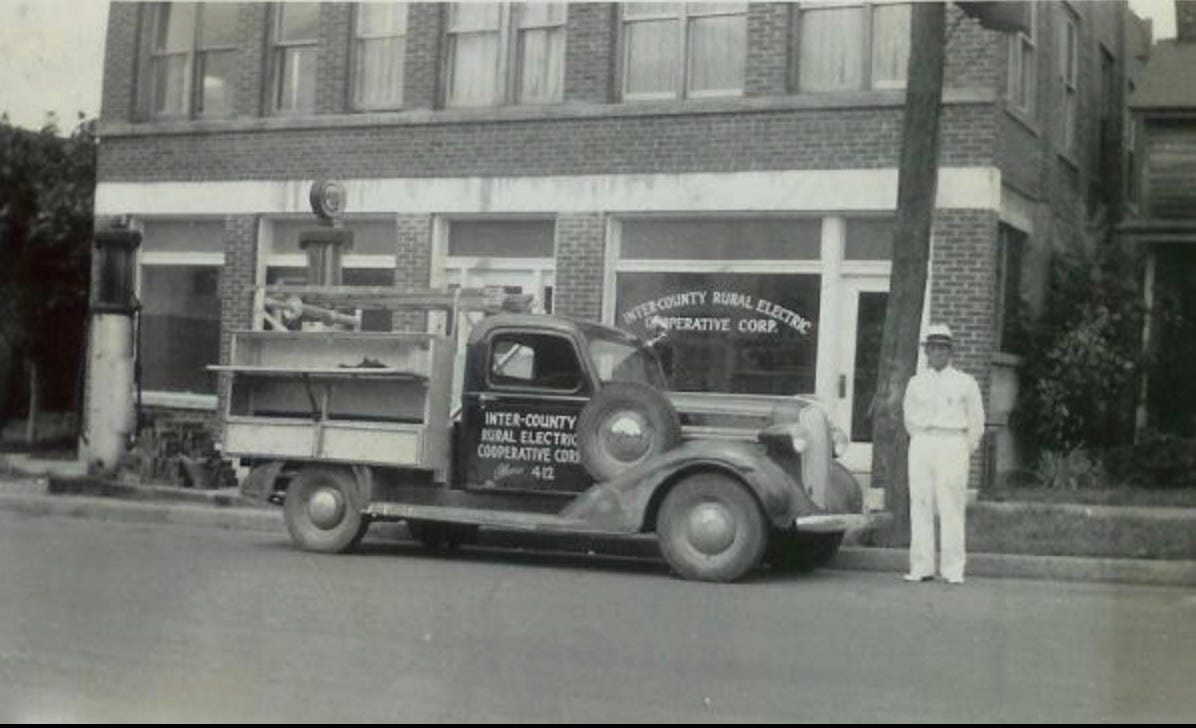
Today approximately 900 of these cooperatives serve 42 million Americans across 56 percent of the nation’s land mass. Many still carry the name of the federal agency that made them possible: Rural Electric Associations, or REAs. The cooperatives it helped create are still here, still member-owned, still governed by local boards. The federal government provided the loans. Communities built and ran the institutions. That distinction matters more now than it ever has.
But electricity was only part of the story. The same dynamic played out everywhere a farmer tried to get a crop to market or an input to the field. In some areas, grain elevators already existed, owned by railroad companies or local businessmen who operated as monopolies, accused regularly of under-grading grain, short-weighting loads, and charging whatever the market would bear because there was nowhere else to go. In others, the infrastructure simply didn’t exist at all, because there wasn’t enough profit in building a grain elevator in Starbuck, Washington for someone who didn’t live there. Either way, farmers had no leverage. The infrastructure of rural economic life was either absent or controlled by entities that set the terms and captured the margin.
So farmers built their own. Grain elevators owned by the growers who used them. Supply co-ops that bought inputs at scale and passed the savings back proportionally. Farm credit institutions and credit unions governed by their members, born from the same impulse to stop being held hostage by lenders who had no stake in whether the farm survived.
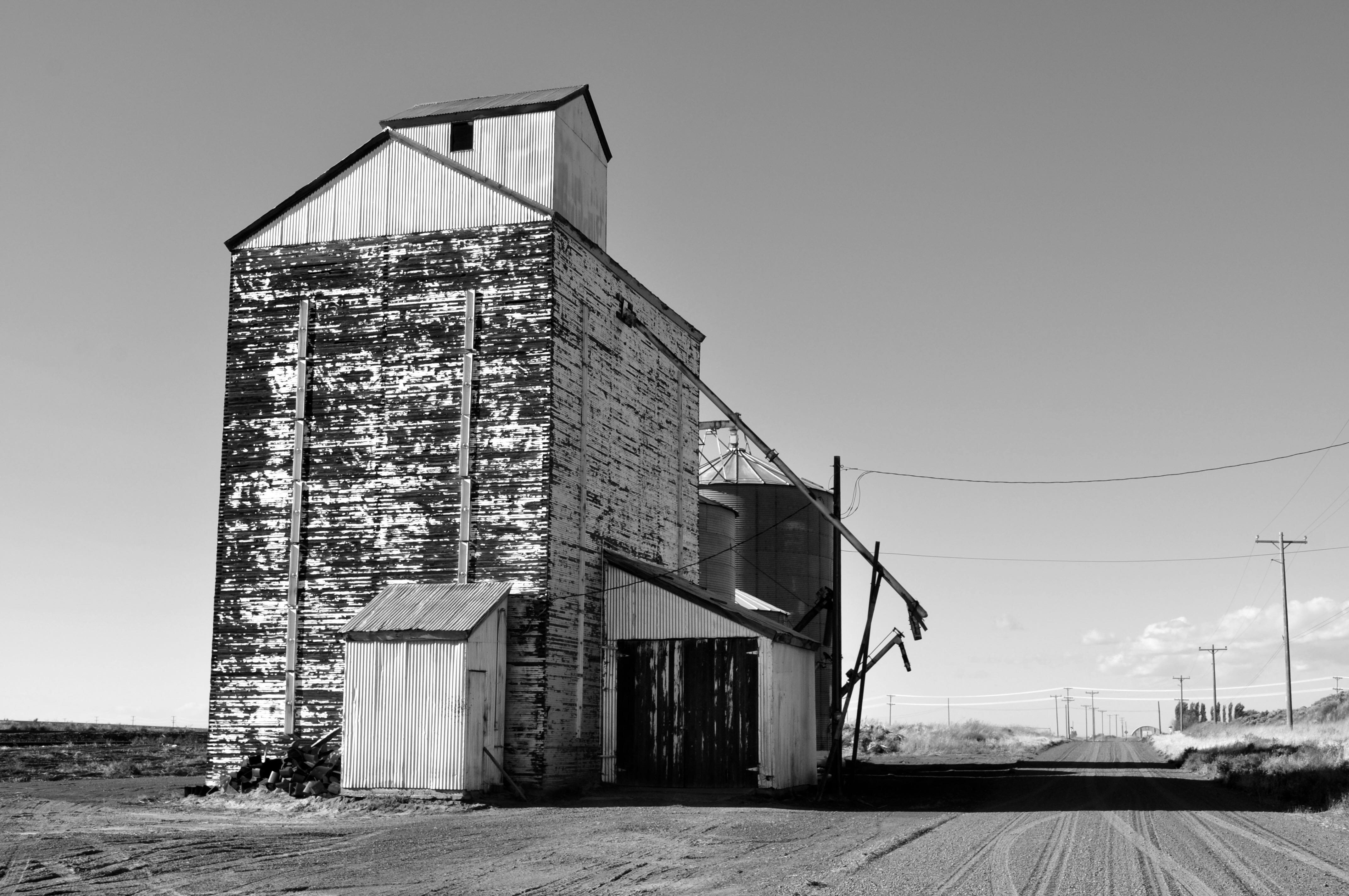
The cooperative model wasn’t a philosophy. It was a tool. The only one available to people who understood that no single farmer could negotiate against a railroad or a bank or a commodity trader, but a thousand farmers speaking through a jointly owned institution could.
Across every one of these institutions, from grain elevators to electric lines, farmers organized, demanded, and fought for change until Washington D.C. had no choice but to respond. The federal government provided the seed capital. Rural communities built the institutions, governed them, and owned them outright within a decade, retiring every dollar of federal capital and running them as fully member-owned institutions ever since.
When Congress passed the Rural Electrification Act in 1936, the private utility lobby fought it hard, calling it socialist overreach. The same label is applied today to nearly any program that pools public resources for community benefit. The irony is not lost that the rural communities built by those programs, the co-ops, the farm credit system, the REAs, are now among the strongest supporters of an administration actively working to dismantle the federal framework that made them possible.
The cooperative model is not a government program. It is not socialism. It is a public-private partnership with a track record spanning a century, one that puts both the generation and the profits in the hands of the people who live on the land.
There’s another version of cooperative history that has been absorbed into a different cultural story entirely. The food co-op in the college town, the collectively run grocery with the bulk bins and the local honey. Rural farmers and urban progressives arrived at the cooperative model from different directions and different pressures. That they ended up in the same place says something important. The impulse to band together against larger structures that don’t have your interests at heart isn’t ideological. It’s human.
I know this world from the inside. Our family’s four-digit REI membership number, earned when the co-op still meant serious mountaineers pooling their buying power against the retail market, was still in my father’s wallet when he died in 2017, in a house powered entirely by solar energy. The mission was never ideological. It was arithmetic. Buying together meant paying less. I’m a member of Benton REA today for exactly the same reason.
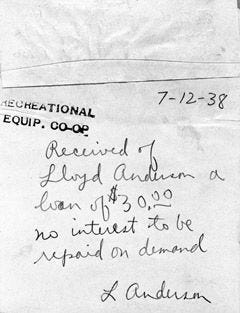
The mountaineer who wanted fair prices on gear, the co-op member who wanted quality food at prices nobody could get alone, the farmer who strung his own power lines because the utility company stopped where the profit did. They were all solving the same problem. The entity across the table was always larger than any one of them. Banding together was how ordinary people built a life they could afford to live in and thrive in.
That’s not a red idea or a blue idea. It’s what the 99 percent have always done when the alternative was being priced out by the 1 percent.
So here is a question few seem to be asking. What if the next chapter of that same story is energy?
A Different Way to Say the Same Thing
Let’s be honest. The phrase “green energy” carries a specific cultural weight. For a lot of rural Americans, particularly those who’ve watched commodity prices get squeezed, watched input costs climb, watched their county seat hollow out, it sounds like something the coastal cities decided they cared about. A luxury. A political signal. Something that costs money they don’t have to solve a problem they didn’t cause.
“Energy independence” lands differently. It always has.
Energy independence means diesel for your irrigation pumps doesn’t wipe out your margin because of a conflict on the other side of the world. Drilling more domestic oil doesn’t solve that problem. Oil is a global commodity priced by multinational corporations and foreign governments, and no amount of domestic production puts American farmers in control of what they pay at the pump.
Real energy independence means owning the generation source itself. That’s a different conversation than the one currently on offer. And it’s one rural America is uniquely positioned to have.
The Pushback Isn’t About Energy. It’s About Extraction.
The distinction between energy independence and large-scale solar and wind projects isn’t subtle to farmers in Eastern Washington. Several counties in the region have passed moratoriums on large-scale solar installations, and the reasoning is straightforward. Yakima County Farm Bureau President Mark Herke dropped the term “solar farm” a long time ago. His term is solar-industrial complexes. He says he isn’t “anti-solar energy.” But the name says everything about the distinction he’s drawing. What’s being offered doesn’t look like independence.
In Washington state, energy companies can bypass county land-use decisions entirely by applying to the state Energy Facility Site Evaluation Council, which has approved projects over the explicit objections of local governments. Outside interests arrive with promises, take what they need, and leave the community with the footprint and none of the equity.
The opposition isn’t necessarily about the energy. It’s about the deal. And nobody is showing up with a different one.
Some of the concerns raised about large solar and wind installations are legitimate and worth taking seriously. Productive crop acres removed from rotation. Familiar landscapes altered by rows of panels or lines of turbines. Questions about wildlife corridors and pollinator habitat. These aren’t invented grievances. They are the reasonable questions of people who have worked land for generations and understand better than anyone what it takes to keep it productive.
But those questions deserve honest answers, which means it’s worth asking who is making sure those questions get asked loudly, repeatedly, and in ways designed to stop the conversation rather than advance it.
Researchers and investigative journalists have documented organized opposition groups, funded in part by fossil fuel interests, deploying identical messaging templates across rural communities nationwide. The same talking points about lost farmland and damaged views that appeared in rural Michigan showed up word for word in rural Ohio, in Texas, in Washington state. That’s not organic community concern. That’s a campaign. And it is most effective in exactly the communities that stand to benefit most from an alternative to the model it’s protecting.
The offers on the table are lease payments. A fixed dollar per acre, paid to the landowner while the developer owns the asset, captures the federal tax credits, and sells the power back to a grid the farmer pays into every month. Small farms are already failing. Tariffs have decimated export markets. Diesel and fertilizer costs have climbed on the back of foreign conflicts. Agribusiness is absorbing the neighbors. And the one resource sitting unused on fallow acres, the wind and the sunlight, is being offered back to farmers on the same extractive terms they’ve been handed for a century and a half.
Consider the corners of a standard center pivot field. The most common center pivot irrigates 126 acres of a 160-acre quarter section. That leaves roughly 34 acres unirrigated across all four corners combined, about 21 percent of the field. Corner arm attachments exist to reach them, but they're an added cost many farmers don't carry.
If you've ever had a window seat on a flight across the middle of this country, you've seen the view: circles upon circles stitched across the land as far as the eye can see. Every one of those circles has corners.
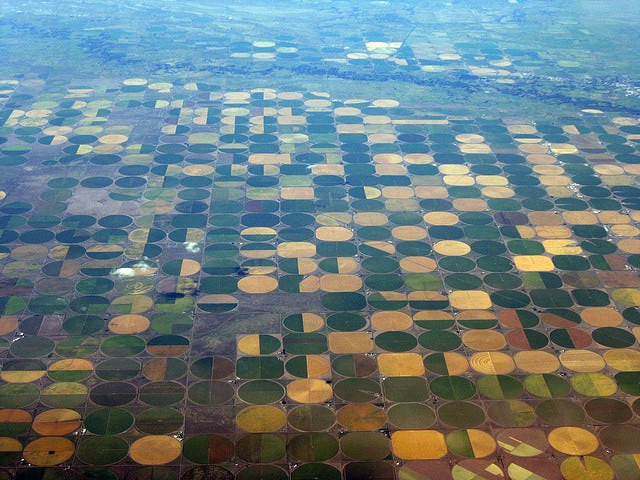
Those corners currently produce no crops and no direct revenue. Some have genuine value as pollinator habitat and wildlife corridors, and that’s worth preserving. Not every corner acre is a candidate for solar. But research on Agrivoltaic systems, panels installed alongside or above managed habitat, suggests the two goals aren’t mutually exclusive.
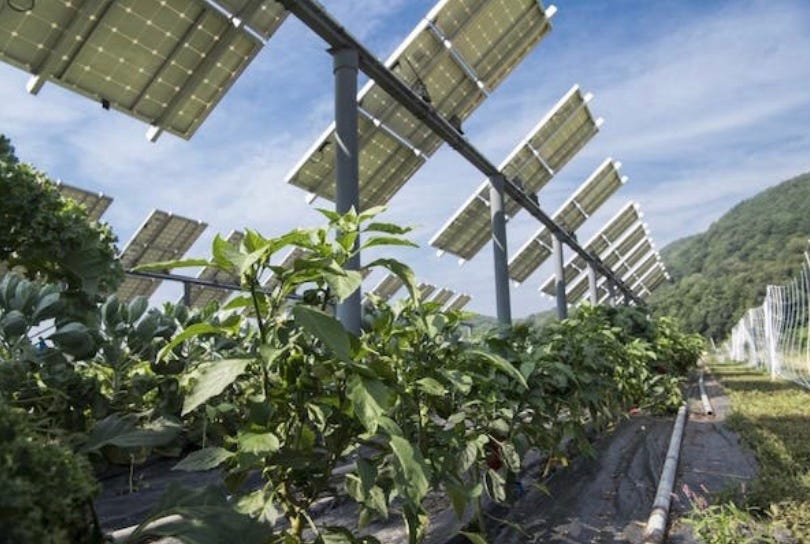
A cooperative could make those determinations field by field, with the farmers who know the land making the calls. That’s the difference between a local institution and a distant developer.
At current solar market rates of $20,000 to $32,000 per acre annually, those 34 combined corner acres represent between $680,000 and just over $1 million in potential annual revenue. For a farmer with multiple quarter sections, that math compounds quickly. That land is sitting in the sun right now.
The sun and the wind above those corners are as much a crop as the wheat in the field. Eastern Washington has all three in abundance. The only question is who gets to harvest them.
What This Could Look Like
Eastern Washington averages 4.8 to 5.8 peak sun hours per day, significantly more than western Washington, putting the Columbia Basin among the stronger solar production zones in the Pacific Northwest. An acre of panels in that sunlight generates roughly 400 megawatt-hours annually, enough to power about 37 to 38 average homes.
Consider Benton REA, the rural electric cooperative serving the area around the Tri-Cities. It is a member-owned institution, governed by the people it serves, with a century of cooperative infrastructure behind it. It also purchases every single kilowatt hour it sells from outside wholesale providers, owns no generation assets, and has no control over the wholesale market that sets its rates.
So what would this actually look like?
Here is what it looks like. A co-op with the member relationships, the distribution infrastructure, and the right-of-way access to finance solar installations on member farmland as a co-op asset, not a lease to an outside investor. Farmers who provide the acreage are compensated not just for the land but for what it produces. The co-op owns the generation asset and captures the production tax credits. Power flows into the local distribution system at a cost lower than wholesale market rates. Rates stabilize. The equity stays in the county.
Benton REA members have already shown they want this. The co-op’s solar program, which helps individual members install panels to reduce their own utility bills, has been so popular it exhausted Washington State’s available incentive funding. That’s demand for the modest version. The will is there. The institution is there.
What is missing is the ownership structure, the profit model, and the conversation that connects both to the farmers who are best positioned to make it work.
Alright, but who pays for the equipment?
The question has a historical answer. The federal government has seeded every major rural cooperative infrastructure buildout through low-interest loan programs that communities paid back over time. The panels, the inverters, the interconnection infrastructure could be financed the same way. The co-op finances the generation asset, members pay it back through a portion of the revenue it generates, and when the loan is retired the asset belongs entirely to the cooperative.
And what about ongoing maintenance and repairs?
Ongoing maintenance is built into the same structure. Solar panels carry 25-year performance warranties. Inverters typically need replacement once in that cycle, at 10 to 15 years. A cooperative sets aside a maintenance reserve from operating revenue, the same way a grain elevator funds its own upkeep, so members never face a surprise assessment. And unlike a corporate installation that imports its own crews, a cooperative contracts its maintenance work locally. The electricians, the technicians, the administrative staff. Those jobs stay in the county. The money stays in the county. That is how every cooperative institution in rural America has always worked.
But isn’t someone already doing this?
The same gap exists in every current energy program in the country. Federal programs help individual farmers install solar on their own land and reduce their utility bills. The farmer bears the capital cost, reduces their bill, and occasionally feeds surplus back to the grid at net metering rates that expire annually. Corporate developers offer lease payments while they own the asset, capture the federal tax credits, and sell the power. The DOE and USDA have acknowledged the missing model themselves, describing their goal as piloting “new and innovative business models” for farmers and rural electric cooperatives to generate actual revenue. They are running workshops. The model doesn’t yet exist in any farmer’s bank account.
What about the regulations?
Some of those regulations exist for legitimate reasons. Some of them exist because the entities that currently profit from the energy market wrote them, funded the campaigns of the people who passed them, and have every incentive to keep them exactly as complicated as they are. If the goal is clean energy adoption at scale, a distributed cooperative model that makes it economically attractive to farmers requires exactly the kind of regulatory examination that the current conversation is too polarized to have. That examination isn’t anti-regulation. It’s pro-farmer. And it leads to the same destination the regulations claim to want.
I’ll be honest. I don’t have the technical expertise to draw the blueprint for how this gets built. But we are not short of people who do. The lawyers, lobbyists, and policy experts who have made the current system work for multinational energy corporations understand every barrier in it. The better question is why those barriers exist, who wrote them, and who benefits from keeping them in place. If the expertise exists to make this work for the largest energy companies in the world, it exists to make it work for the REAs and the farmers who have been working this land for generations.
Getting There Together
Whatever you call it, green energy, renewable energy, clean energy, energy independence, the question underneath the label is the same one rural America has been answering for over a century. Who owns it? Who controls it? Who benefits when it works?
The same rural communities that spent a generation fighting to get power lines run to their land have had the wind and the sunlight all along. The technology to turn them into a revenue stream is what I’m proposing. At a moment when small farmers are under more economic pressure than at any point in a generation, that isn’t just poetic symmetry. It’s a revenue stream hiding in broad daylight.
The goal of saving the planet is real and urgent. But if the farmer motivated by profit and the advocate motivated by climate arrive at the same field, the same panels, the same community-owned cooperative, and they do.
To the conservative reader: the cooperative model isn’t socialism. It’s the same model your grandparents used to get power to your county. To the progressive reader: you already believe in this. You already live it. The only thing being asked is whether you can support it when the person benefiting doesn’t share your politics.
The language we use to get there matters less than getting there together.
Smart Ruminations is 100% subscriber-supported. No advertisers. No institutional funding. No donor class to answer to. Only you.
For four years I’ve written about the gap between the America we were promised and the one being built around us. If it’s the kind of analysis you want to exist in the world: factual, non-tribal, willing to follow an argument wherever the evidence leads regardless of whose politics it complicates, I’d be grateful for your support.
Paid subscriptions are just $5 a month. Every dollar goes directly toward the research and writing that makes pieces like this one possible. I mean it when I say that your support means the world to me. It’s what allows me to keep doing this work independently, on my own terms, accountable only to the readers who make it worth doing.
For a limited time, new paid subscribers receive 10% off.
References & Further Reading
Rural Electric Cooperatives
National Rural Electric Cooperative Association (NRECA): https://www.electric.coop
Benton Rural Electric Association: https://www.bentonrea.org
Inland Power & Light Cooperative: https://www.inlandpower.com
Benton REA Solar Program (incentive cap confirmed): https://www.bentonrea.org/solar
Washington utilities reach solar incentive cap (Utility Dive, 2016): https://www.utilitydive.com/news/washington-utilities-reach-solar-incentive-cap-foreshadowing-net-metering/419310/
Rural Electrification History
USDA Rural Development — History of Rural Electric Cooperatives: https://www.rd.usda.gov/about-rd/agencies/rural-utilities-service
Rural Electrification Act (1936) — National Archives: https://www.archives.gov/milestone-documents/rural-electrification-act
Farm Credit System history and federal capital repayment: https://www.fca.gov/about-fca/farm-credit-system/fca-history
Eastern Washington Solar Resources
NREL Solar Resource Data for Washington State: https://www.nrel.gov/gis/solar.html
Washington State Solar Incentive Program (WSU Energy Program): https://www.energy.wsu.edu/RenewableEnergy/RenewableEnergySystemIncentiveProgram.aspx
Center Pivot Irrigation
USDA National Agricultural Statistics Service — Irrigated Agriculture Data: https://www.nass.usda.gov
Center pivot irrigation corner acreage data: https://www.irrigation.org
Yakima County Farm Bureau / Eastern Washington Solar Opposition
Yakima County solar moratorium and Mark Herke quote on solar-industrial complexes (Yakima Herald): https://www.yakimaherald.com
Washington State Energy Facility Site Evaluation Council (EFSEC): https://www.efsec.wa.gov
Denmark Cooperative Energy Model
Danish Energy Agency — Wind energy cooperative history: https://www.ens.dk/en
Middelgrunden Wind Cooperative: https://www.middelgrunden.dk/middelgrunden/?q=en/node/6
Fossil Fuel Industry Opposition to Renewable Energy
E&E Legal and rural renewable energy opposition (documented in investigative reporting): https://www.desmog.com
Ohio utility scandal and solar farm opposition: https://www.ohiocapitaljournal.com
Cooperative Economics
National Cooperative Business Association: https://www.ncba.coop
La Montañita Food Co-op: https://lamontanita.coop
REI Co-op history: https://www.rei.com/about-rei/history
Federal Agricultural Cooperative Programs
USDA Rural Energy for America Program (REAP): https://www.rd.usda.gov/programs-services/energy-programs/rural-energy-america-program-renewable-energy-systems-energy-efficiency-improvement-guaranteed-loans
DOE Rural and Agricultural Energy Initiative: https://www.energy.gov/eere/ruralagriculture
Agrivoltaics: Solar and Farming Together
Daniels, Tom and Harry Hale. “Agrivoltaic Options and Designs at the New Bolton Center of the University of Pennsylvania Veterinary School.” Kleinman Center for Energy Policy, University of Pennsylvania, November 2025: https://kleinmanenergy.upenn.edu/research/publications/agrivoltaic-options-and-designs-at-the-new-bolton-center-of-the-university-of-pennsylvania-veterinary-school/
NREL Agrivoltaics Research: https://www.nrel.gov/solar/agrivoltaics.html
Solar Panel Lifespan and Performance
U.S. Department of Energy — Solar panel lifespan data: https://www.energy.gov/eere/solar/articles/solar-photovoltaic-technology-basics
Agrivoltaic systems research: https://www.nrel.gov/solar/agrivoltaics.html
Credit Union History and 2008 Financial Crisis
National Credit Union Administration (NCUA) — History: https://www.ncua.gov/about/history
NCUA Corporate System Resolution Program: https://www.ncua.gov/regulation-supervision/regulatory-and-supervisory-information/corporate-credit-union-resolution
Great article about co-ops. I just received a very nice dividend check from our local grain cooperative. My dad always talked of how when both a local an electrical coop and a telephone coop wanted to set up in our county seat how the local main street businessmen revolted. They didn't want any "communists" coming into our town. So the 2 coops set up on nearby smaller towns and are now the largest employers in the area. Narrow minded people. Thank you Dani for your writings. James Holte
Brava Dani ! Well done; research and composition spot on. The more I read you, the more I'm certain that we are 'on the same page' and that you too are struggling to 'sell it' - so to speak. Brava ~